
Last updated: September 20, 2026
Most roasters come to their first bag order with a logo and a size, and discover that neither is the hard part. The hard part is a short list of production decisions that have nothing to do with design: whether the bag has a valve, what the film has to keep out, and whether the seal matches the machine that will actually fill it. Get those three right and the artwork is the easy afternoon. Get them wrong and you find out on the fill line, with pallets of film already in the building. This is a plain walk through what to settle before a custom stand-up pouch order goes to print.
None of it is exotic. It is just the part of the process nobody writes down for a roaster buying bags for the first time.
Table of Contents
- Start with the valve
- Can you get a custom coffee bag made?
- What the film has to keep out
- The seal spec belongs to whoever fills the bag
- Zippers, gussets and windows
- How much artwork a coffee bag can hold
- What drives the cost of a bag order
- How many bags you actually have to buy
- FAQ
Start with the valve
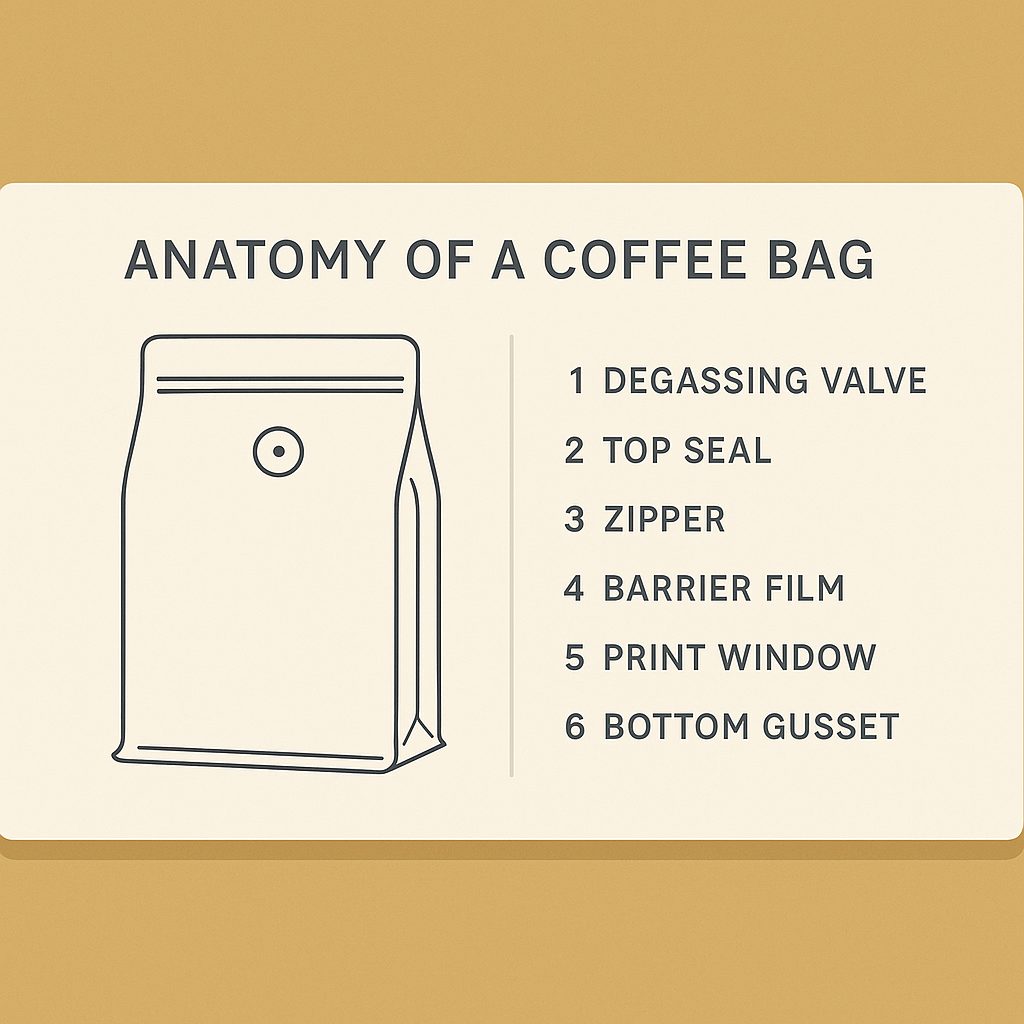
A one-way degassing valve lets fresh-roasted beans release carbon dioxide without letting oxygen back in. Roasted coffee keeps off-gassing for days after it leaves the roaster, and a sealed bag with nowhere for that gas to go will swell, strain its seams, and occasionally burst on a shelf. The valve is not a premium feature. For fresh coffee it is the baseline.
The alternative that some roasters reach for, leaving the bag slightly open or using a non-barrier bag, trades one problem for a worse one. Oxygen is the main agent of staling in roasted coffee, and a bag that vents freely in both directions lets it in. The valve exists precisely because those two requirements pull in opposite directions: gas out, air not in.
The timing question matters more than roasters expect. Coffee packed immediately after roasting degasses hardest, and ground coffee releases its gas much faster than whole bean because there is vastly more surface area. If you pack ground coffee same-day, the valve is carrying real load. If you rest beans for a day or two before packing, it is carrying less, but the bag still needs it. The National Coffee Association and the Specialty Coffee Association both treat protection from oxygen as the central storage variable for roasted coffee.
Can you get a custom coffee bag made?
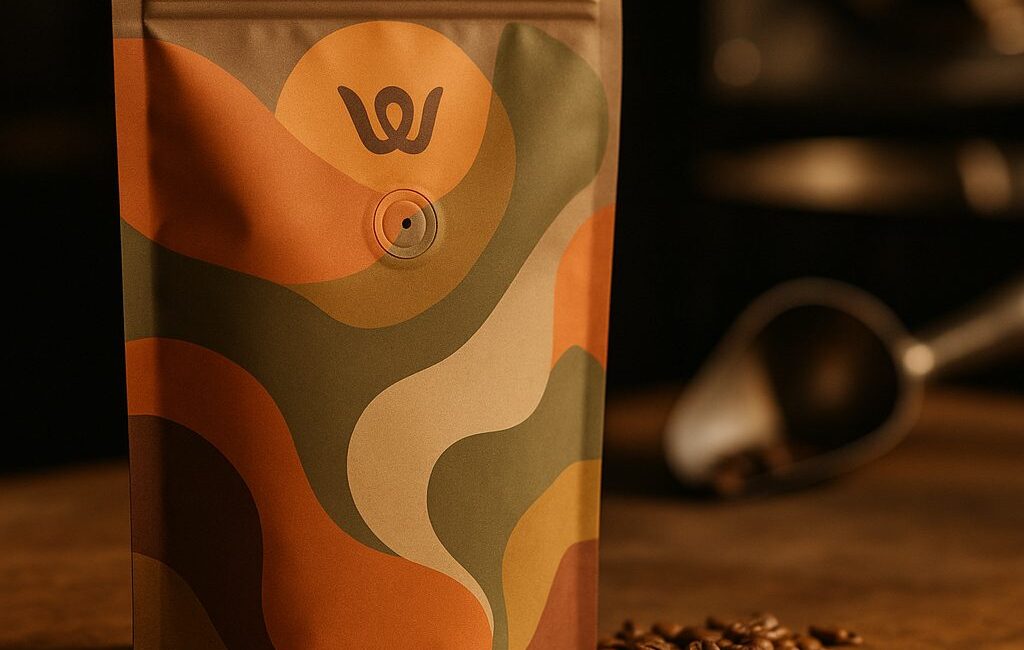
Yes, and at much lower volumes than the category’s reputation suggests. A printed coffee bag is a stand-up pouch with two coffee-specific requirements added: a one-way degassing valve, and a top seal specification that matches the roaster’s fill line. Both are ordinary parts of a pouch spec, not custom engineering.
The practical route for a small roaster is not a stock bag with a sticker on it. Stock bags with applied labels are how most roasters start, and they work, but they cap what the package can look like and they add a labor step to every single bag. Printed film gives you edge-to-edge artwork with no label to apply, and once digital production removes the plate step, the volume required to justify it drops sharply.
What you need to bring to the conversation is smaller than you would think: the weight you are packing, whether it is whole bean or ground, roughly how many bags, and who is filling them. Dimensions can be worked backward from the fill weight and the bean density. Artwork can come later.
What the film has to keep out
Coffee has four enemies: oxygen, moisture, light and heat. The film structure is the part of the bag that handles the first three, and a high-barrier laminate is what the category uses because a single-layer film does not hold up against all of them at once.
Barrier level is a spec decision with a real cost attached, and it should be matched to shelf life rather than maximized by reflex. A bag that moves through a farmers market in ten days is protecting against a different timeline than one sitting in a grocery distribution chain for four months. Overspecifying barrier is a common way to spend money that never shows up as quality in the cup.
Light is the one people forget. An opaque or heavily printed bag blocks it; a clear window lets it in. That trade-off is worth making deliberately, because a window that shows off a beautiful bean also exposes it, and the size and placement of the window is where the decision actually gets made.
The seal spec belongs to whoever fills the bag
The single most expensive mistake in a first bag order is specifying a bag without talking to the people or the machine that will fill and seal it. A bag that is perfect on paper and wrong at the sealing jaws is scrap.
The top seal spec needs to match the fill line: the seal width the machine expects, how much headspace it leaves, and how the bag is presented to it. A roaster filling by hand and sealing with a tabletop impulse sealer has different requirements than a co-packer running an automated line, and the bag can be built either way as long as somebody asks first. White Graphics builds that spec against the roaster or co-packer’s line, so the bag that lands is made for that equipment rather than adapted to it afterwards.
If you are planning to move from hand filling to a co-packer within the year, say so during the first order. It is far cheaper to build a bag that will survive the transition than to redesign the package at the moment you finally get the volume that made the move worthwhile.
Zippers, gussets and windows
A stand-up pouch does its selling in the few seconds a shopper holds it. The bottom gusset keeps it upright on the shelf. The zipper promises freshness after the first pour. Edge-to-edge print gives the brand every square inch of film to make its case. Each of those is a separate line on the spec, and each has a cost.
A zipper is the feature most worth arguing about. For whole bean sold in twelve-ounce retail sizes, a resealable zipper is close to expected, because the customer opens the bag many times over two weeks. For single-serve sizes or for wholesale bags that get decanted into a hopper once, it is cost with no purpose. Let the way the bag is actually used decide it, not the way competitors’ bags look.
Windows are handled with a spot of white ink rather than a hole in the film. A full flood of white behind the artwork gives maximum color punch; a spot white lets you drop a window into the art so the product shows through. It has to register tightly to the color above it, or you get pale halos at every edge. That registration is the craft part, and it is worth asking to see on a proof rather than taking on trust.
How much artwork a coffee bag can hold
More than a label, and in more places. A printed pouch has a front panel, a back panel, two side gussets and a bottom, and each of those is usable surface. The front carries the brand and the origin; the back is where the story, the roast level, the tasting notes and the legal copy live comfortably without crowding.
The constraint is not space, it is the seal and the valve. Artwork has to stay clear of the seal zones, because ink in a seal area can interfere with the bond, and it has to account for the valve’s position on whichever panel it sits. Those keep-clear areas are defined before design starts and they are not negotiable later.
Legal copy for packaged coffee follows standard food labeling: net weight, ingredient and allergen statements where applicable, and the responsible party’s name and address. The FDA’s food ingredients and packaging guidance is the starting reference, and anything decaffeinated, flavored or sold with a nutrition claim deserves a closer read before the file locks.
What drives the cost of a bag order
Five things, roughly in order: bag size, the film structure and barrier level the coffee needs, run length, features like zippers, hang holes and valve provisions, and how many artwork versions ride the run.
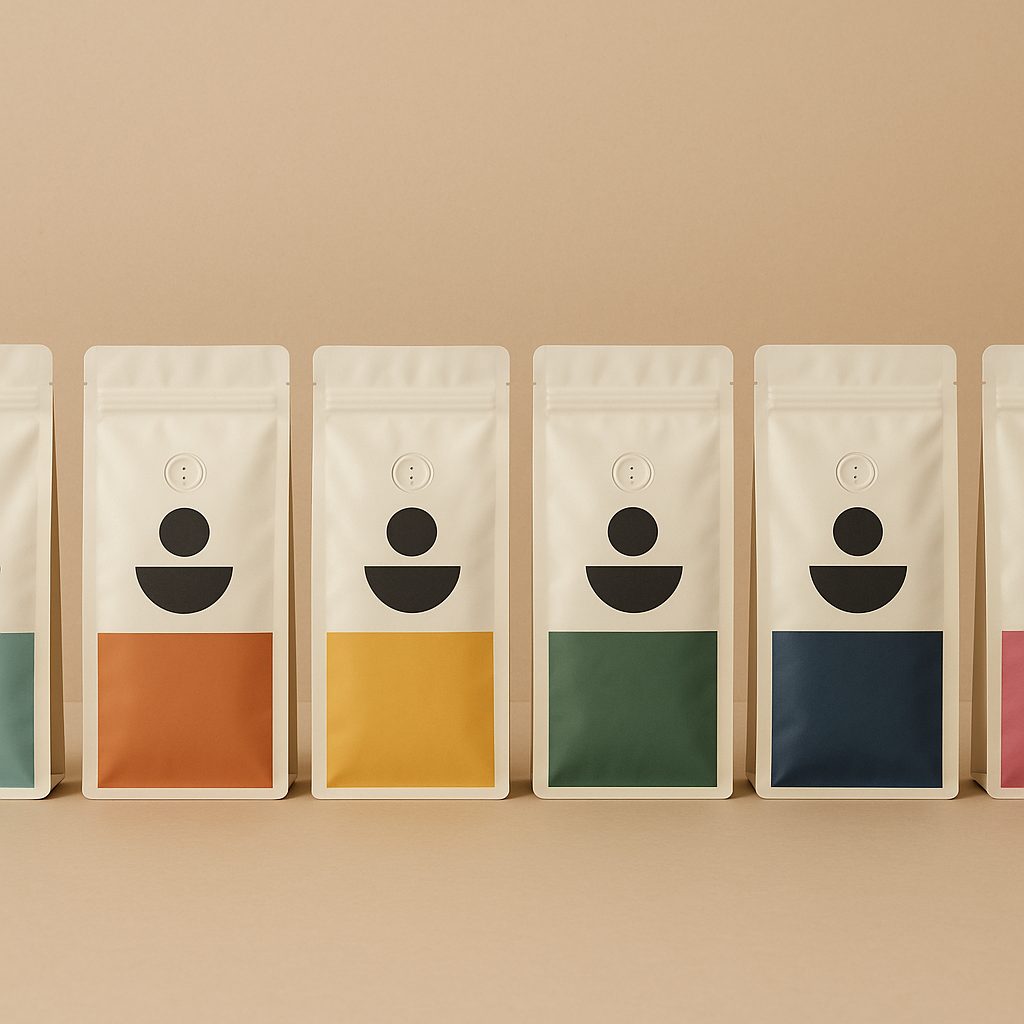
That last one is the lever most roasters do not know they have. A roaster with six single-origin offerings usually assumes six separate print jobs. On a digital press there are no plates to make between versions, so those six can often be produced across one run rather than six setups. It changes how a small roaster can build a lineup, because the cost of adding the seventh origin stops being a full print job.
Barrier and size are the two that quietly inflate. A larger bag uses more film per unit, and a higher barrier structure costs more per square inch. Both are worth spending on when the shelf life demands it and worth trimming when it does not.
How many bags you actually have to buy
Lower than most roasters expect. Because the work runs on digital presses with no plates to make, printed pouch runs start well below the five-figure minimums that the category is known for. That makes the format workable for a seasonal offering or a single-origin test as readily as for a year-round flagship.
The strategic use of that is testing. A roaster can put a real printed bag in front of real customers before committing a year of packaging budget to it, which is the same argument behind short-run packaging generally. A design that looks right on a monitor and wrong in a hand is cheap to discover at three hundred bags and expensive to discover at thirty thousand.
Quantities get scoped rather than quoted off a chart, because the five cost drivers above interact. Sending the fill weight, the barrier expectation and a rough annual volume produces a far more useful number than asking for a price per bag.
FAQ
Can I get a custom coffee bag made with my own design?
Yes. A custom coffee bag is a printed stand-up pouch with a one-way degassing valve and a seal spec matched to your fill line. Artwork prints edge to edge on the film, so there is no label to apply, and digital production means the run does not have to be large to justify it.
Do coffee bags really need a degassing valve?
For fresh-roasted coffee, yes. Roasted beans release carbon dioxide for days after roasting. A sealed bag with no valve swells and can burst; a bag left open to vent lets oxygen in and stales the coffee. The one-way valve solves both at once.
Can I make my own coffee bags?
You can start with stock bags and applied labels, and many roasters do. It works, but it limits the artwork to the label’s footprint and adds a labor step to every bag. Printed film removes both, and the volume needed to justify it is lower than it used to be.
What size coffee bag should I order?
Size follows fill weight and bean density rather than the other way around, so start from what you are packing and whether it is whole bean or ground. Ground coffee packs denser than whole bean at the same weight, which changes the bag dimensions for the same label claim.
Should my coffee bag have a window?
Only if showing the bean is worth the light exposure. A window is created with a spot of white ink rather than a hole, so it can be any size and shape, but light is one of the four things that degrade roasted coffee. Small and deliberate beats large and decorative.
Bring the fill weight, not the finished artwork
The most useful first conversation about a coffee bag is about grams, barrier and who seals it. Request a quote from White Graphics with your fill weight, rough volume and how the bags get filled, and the spec can be built backward from there. The format is covered in production detail on the custom stand-up pouches page, and sits alongside shrink sleeves and flow wrap in the guide to flexible packaging.
About the publisher
White Graphics is a G7 Master qualified custom label and packaging company managed out of Naperville, Illinois, serving food, beverage, supplement, cosmetic, and household-product brands across North America since 1972. Learn more about the company or see the full range of capabilities.