
Last updated: September 20, 2026
Search for custom pouches and the results split into two camps that never quite explain themselves. One camp quotes enormous minimums and talks about tooling. The other advertises no minimum at all and shows you a bag that is not really printed. Neither is lying, exactly. They are describing two different manufacturing routes, and the gap between them is where most small brands lose a month. This is what actually sets the floor on a custom stand-up pouch order, what you give up at each end, and how to compare two quotes that are not describing the same thing.
The short answer, for anyone who wants it now: printed pouch minimums are far lower than the category’s reputation, but they are not zero, and the reason why is worth understanding before you buy.
Table of Contents
- Why pouch minimums exist at all
- What “no minimum” usually means
- What is the minimum order for custom printed pouches?
- What drives the cost of a short pouch run
- Running six flavors through one setup
- What a few hundred pouches is actually good for
- Where the format earns its keep
- What to send with a quote request
- FAQ
Why pouch minimums exist at all
Traditional pouch minimums are a tooling story, not a greed story. Conventional flexible printing requires a physical image carrier to be made for every color in the design, plus setup and waste while the press comes into register. That fixed cost has to be spread across the run, so the quoted minimum is really the volume at which the setup stops dominating the unit price.
The consequence for a small brand is brutal and slightly absurd: the fixed cost does not care whether you wanted five thousand bags or fifty thousand, so a brand testing an idea pays roughly the same setup as a national rollout. That is the reason a first-time founder gets quoted a number that looks like it was meant for someone else. It was.
Digital printing removes that step rather than discounting it. With no image carriers to produce, the fixed cost at the front of the job largely disappears, and the economics stop punishing short runs. That is the single change underneath every low-minimum pouch offer worth taking seriously.
What “no minimum” usually means
Most “no minimum” pouch offers are selling a stock bag with a printed label applied to it. That is a legitimate product and a reasonable way to start, but it is not a printed pouch, and comparing its price against a printed quote is comparing two different things.
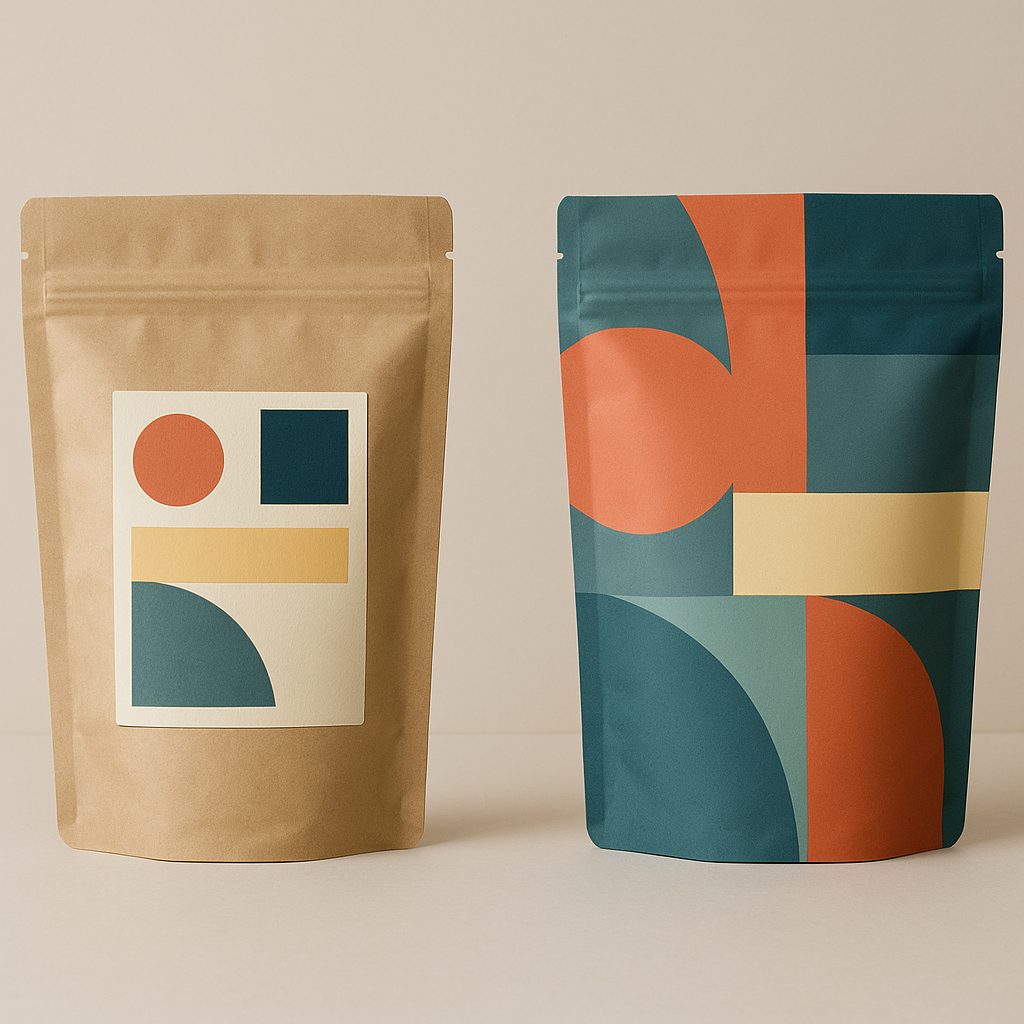
The differences show up on a shelf. A labeled stock bag has a visible label edge, artwork confined to the label’s footprint, and a bag color chosen from whatever the supplier stocks. A printed pouch carries art edge to edge across the front, the back, the gussets and the bottom, with no label to lift, bubble or peel in a humid warehouse. One of those looks like a brand that has arrived; the other looks like a brand that is testing, which is fine if testing is what you are doing.
There is also a labor cost that quotes rarely surface. Somebody has to apply every label, by hand or by machine, on every bag. At two hundred bags that is an afternoon. At five thousand it is a real line item that was never in the comparison.
What is the minimum order for custom printed pouches?
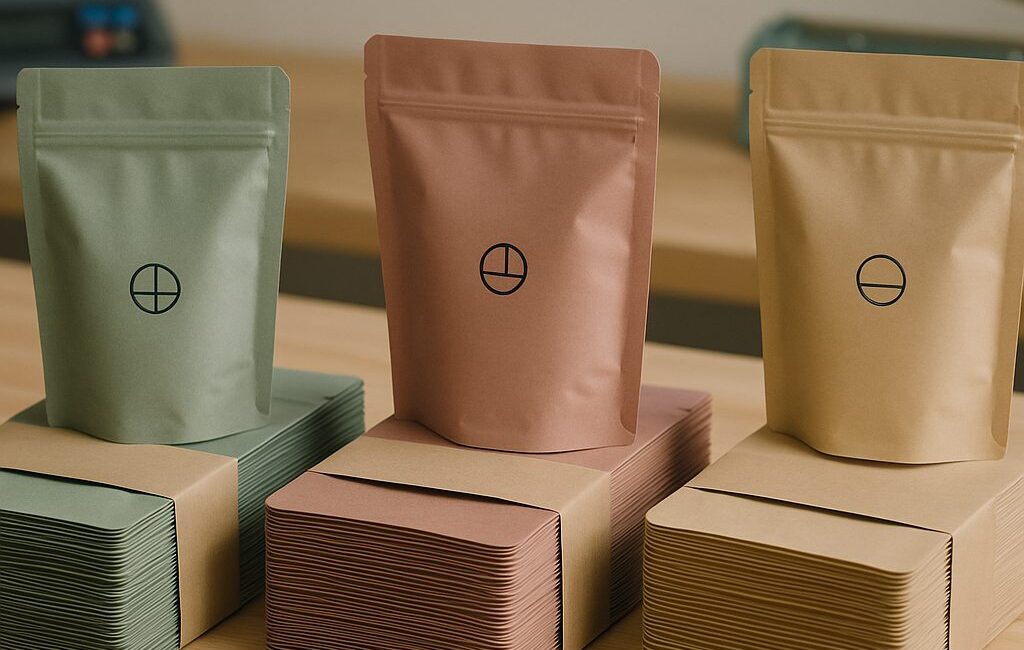
Lower than most brands expect. Because the work runs on digital presses with no plates to make, a printed pouch run does not need the five-figure volume the format is known for, and a few hundred pieces is a workable quantity. That makes a printed pouch practical for a flavor test or a farmers-market season as readily as for a national rollout.
What it is not is zero. There is still film to order, a press to set up, and finishing to run, so there is a point below which the per-unit number stops making sense for anybody. The honest framing is that the floor moved down by an order of magnitude, not that it disappeared.
Quantities get scoped rather than read off a chart, because the cost drivers interact with each other. A small run of a large high-barrier bag and a small run of a modest one are not the same job, and a single published minimum would be wrong for both.
What drives the cost of a short pouch run
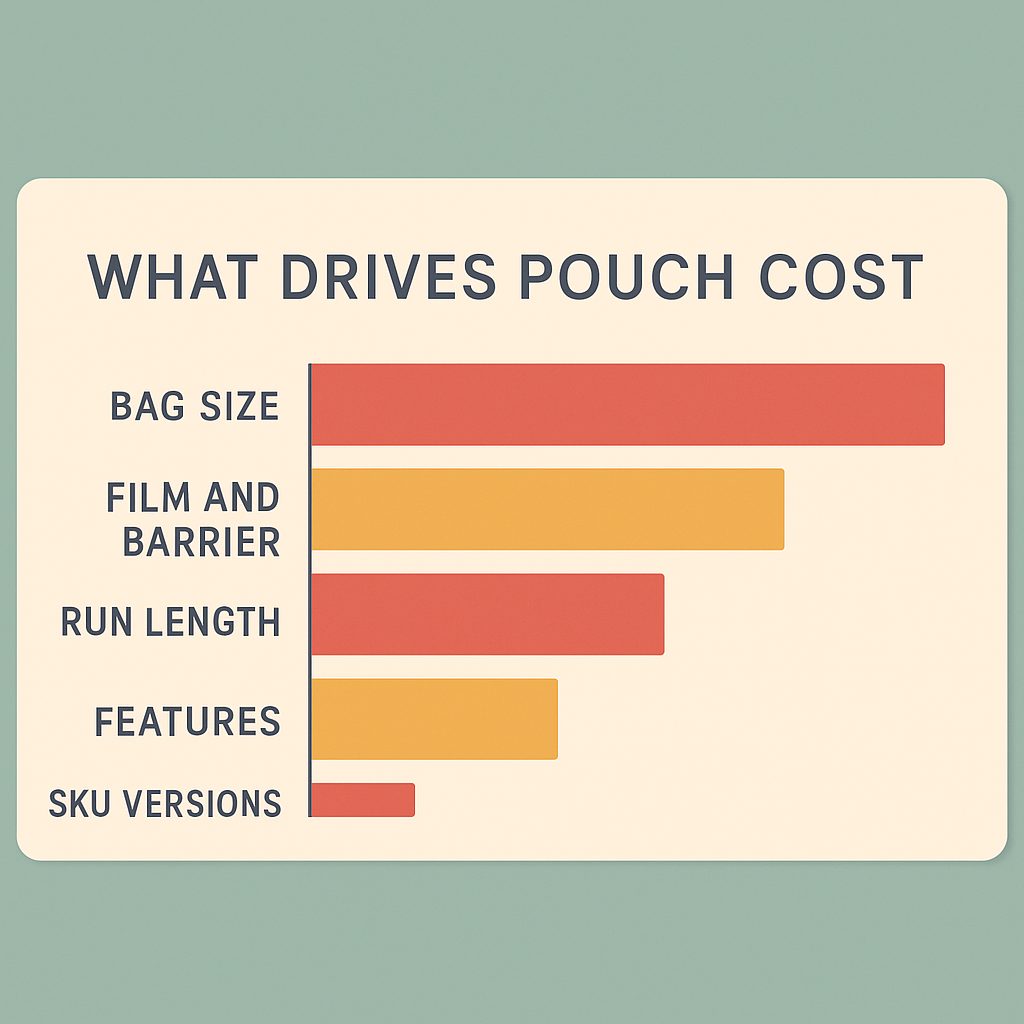
Five things, roughly in order of impact: pouch size, the film structure and barrier level the product needs, run length, features like zippers, hang holes and valve provisions, and how many SKU versions ride the run.
Size and barrier are the two that inflate quietly. A larger pouch consumes more film per unit, and a higher barrier structure costs more per square inch, so a big bag protecting a long shelf life is paying twice. Both are worth spending on when the product genuinely needs them, and both are worth trimming when the honest shelf life is six weeks rather than six months.
Barrier is also where food compliance enters. A pouch is in direct contact with what it holds, which puts the film squarely inside food-contact regulation rather than adjacent to it. The FDA’s food ingredients and packaging guidance is the reference for what that means, and the Flexible Packaging Association is a useful neutral source on how the structures are built. Neither is a reason to overspecify, but both are a reason to name the product honestly at quote time rather than describing it as “dry goods” and sorting it out later.
Features are easier to reason about, because each one maps to something the customer does. A zipper earns its cost on a product the customer opens repeatedly. A hang hole earns its cost if the bag is merchandised on a peg rather than a shelf. A valve provision earns its cost on coffee and on very little else. Specifying features by habit rather than by use is the most common way a short run gets expensive.
Running six flavors through one setup
The cost driver most brands do not know they have is version count. Because there are no plates to remake between designs, a family of flavors can often be produced across one run rather than one setup per flavor.
That inverts how a small brand plans a lineup. Under conventional printing, every additional SKU is a separate job with a separate minimum, which is why young brands are told to launch with one product and expand later. When versions ride a single run, the marginal cost of the fourth flavor is film and a file, not a new setup. Launching with a range becomes a real option rather than a luxury.
It also makes seasonal and limited releases sane. A holiday version, a collaboration, a single-origin, a regional variant: each of these stops being a project and starts being a line on an existing order.
What a few hundred pouches is actually good for
Three things, and they are all about buying information before buying inventory.
Shelf tests. A design that reads beautifully on a monitor can disappear on a shelf next to competitors, and the only way to know is to put the real bag in the real place. Three hundred printed bags answers that question for the cost of a rounding error on a full run.
Buyer meetings. A retail buyer responds differently to a finished package than to a rendering. A short run produces the real thing to put on the table, which is the same logic behind sales samples and prototype packaging in every other format.
Fill line trials. Running a few hundred bags through the actual filling and sealing equipment surfaces the mismatches that no spec sheet catches. Finding a seal problem at three hundred bags is a conversation. Finding it at thirty thousand is a write-off.
Where the format earns its keep
Four categories account for most of the pouch work that comes through the door, and each one pulls the spec in a slightly different direction.
Coffee leads by a wide margin, and carries two requirements the others skip: a one-way degassing valve so fresh-roasted beans can off-gas without bloating the bag, and a top seal spec matched to the roaster’s fill line. The custom coffee bag guide covers that spec in detail.
Granola and snack want a high-barrier laminate to keep the crunch, and often a spot-white window that shows the product without giving up printed real estate.
Pet treats run heavier fill weights, which wants a wider gusset, and they get opened every single day, which wants a zipper built for that kind of use rather than a token one.
Pantry goods, meaning spices, baking mixes and dry staples, are usually the least demanding on barrier and the most demanding on the artwork, because the category is crowded and the products look alike in the hand.
What to send with a quote request
A useful quote needs four things, and finished artwork is not one of them. Send the fill weight or volume, what the product is, roughly how many pouches and over what period, and whether the bags are filled by hand or on a line. Everything else can be worked out from there, including dimensions.
Two optional details sharpen a quote considerably. The honest shelf life you need, which sets barrier, and the number of SKU versions you expect to run, which is where the savings live. Brands often leave the second one out because they assume it will raise the price, when it usually lowers the price per bag.
Whatever the run length, a proof gets approved before production, so what lands on the fill line matches what was signed. That step does not get skipped because a run is small.
FAQ
Is there a true no-minimum custom pouch?
Not for printed film. Offers advertising no minimum are almost always stock bags with applied labels, which is a different product. Printed pouch runs on digital presses start far below traditional minimums, often in the hundreds, but there is still a practical floor.
How many custom pouches do I have to order?
Fewer than the five-figure numbers the category is known for. Digital production removes the plate step, so a few hundred pieces is a workable run. The exact floor depends on bag size, barrier level and features, so quantities get scoped rather than quoted from a chart.
Are printed pouches worth it over stock bags with labels?
Once you are past testing, usually yes. Printed film gives edge-to-edge artwork with no label edge, nothing to peel in humidity, and no labor step on every bag. Stock bags with labels remain a sensible way to validate an idea before committing.
Can I print several flavors in one order?
Yes, and it is the cheapest thing you can do on a digital run. With no plates to remake between versions, a family of SKUs can often be produced across one run rather than one setup each, so the marginal cost of an additional flavor is film and a file.
What makes one pouch quote higher than another?
Usually size and barrier level, which are the two drivers that scale with every unit. After that, run length, features like zippers and hang holes, and version count. Two quotes can also differ because one is for printed film and the other is for a labeled stock bag.
Get a number that matches your actual run
The fastest way to a useful answer is the product, the fill weight, the rough volume and how the bags get filled. Request a quote from White Graphics with those four and the spec can be built around them. The format runs in production detail on the custom stand-up pouches page, and short-run economics apply across formats, as covered in short-run packaging and the guide to flexible packaging.
About the publisher
White Graphics is a G7 Master qualified custom label and packaging company managed out of Naperville, Illinois, serving food, beverage, supplement, cosmetic, and household-product brands across North America since 1972. Learn more about the company or see the full range of capabilities.