
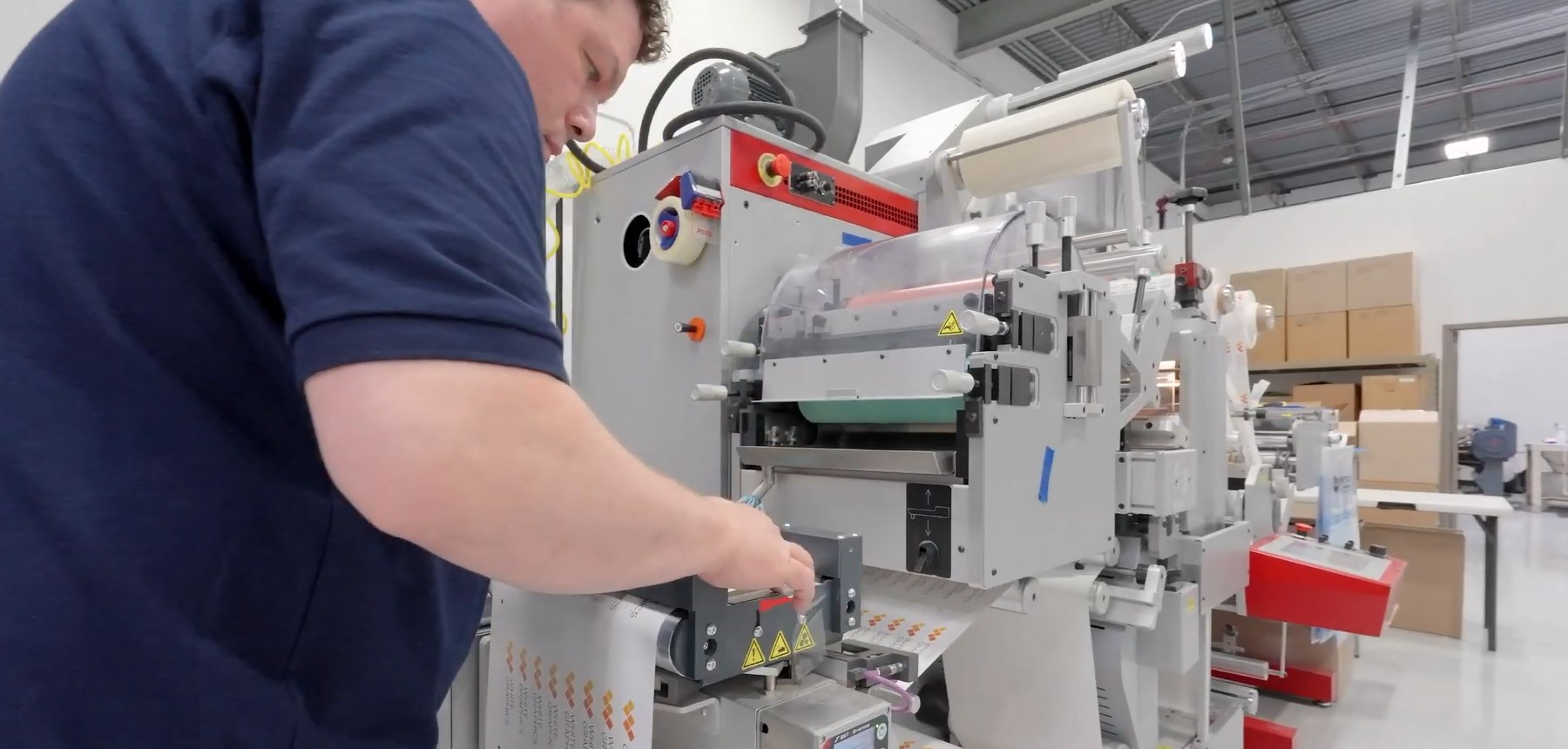
Flow wrap packaging, printed for your wrapper.
Rollstock built to your wrapper's spec, managed from Naperville, Illinois: one partner from first prototype to full production, and film that arrives ready for your line or your co-packer's.
What flow wrap packaging is, and when to choose it.
Flow wrapping is horizontal form-fill-seal: a wrapper pulls printed film off a roll, forms it into a tube around the product, seals it lengthwise with a crimped fin seal down the back, then crimps and cuts each end. The result is the familiar pillow pack around a snack bar or a bar of soap. Machine makers call it HFFS; you will also hear horizontal flow wrap or flow pack. Different names, same process: film becoming the package around a moving product.
One thing to be clear about before anything else: White Graphics is not a machine vendor. We print and supply the film, the rollstock your equipment feeds on. The wrapping itself runs on your machine or your co-packer's. Our job is making sure the roll that shows up registers cleanly on that equipment: right repeat, right eye marks, right unwind, right core.
The format wins wherever unit count is high and each unit is small: multipack snack components, single-serve portions, sampling programs, anything wrapped by the hundred per minute. Film priced by the roll beats a formed pouch or a carton at that volume. It is one of several structures we build; the custom retail packaging pillar walks through how the formats compare when you are still choosing.
Watch printed flow wrap film come together.
Read the video transcript
With flow wrap, the film is the package. White Graphics prints rollstock to your wrapper's spec: matched repeat, eye marks, and unwind. Bakery, bars, and confection, printed and rewound, ready for your line. White Graphics, Naperville. Since nineteen seventy-two.
How printed flow wrap film meets your wrapper.
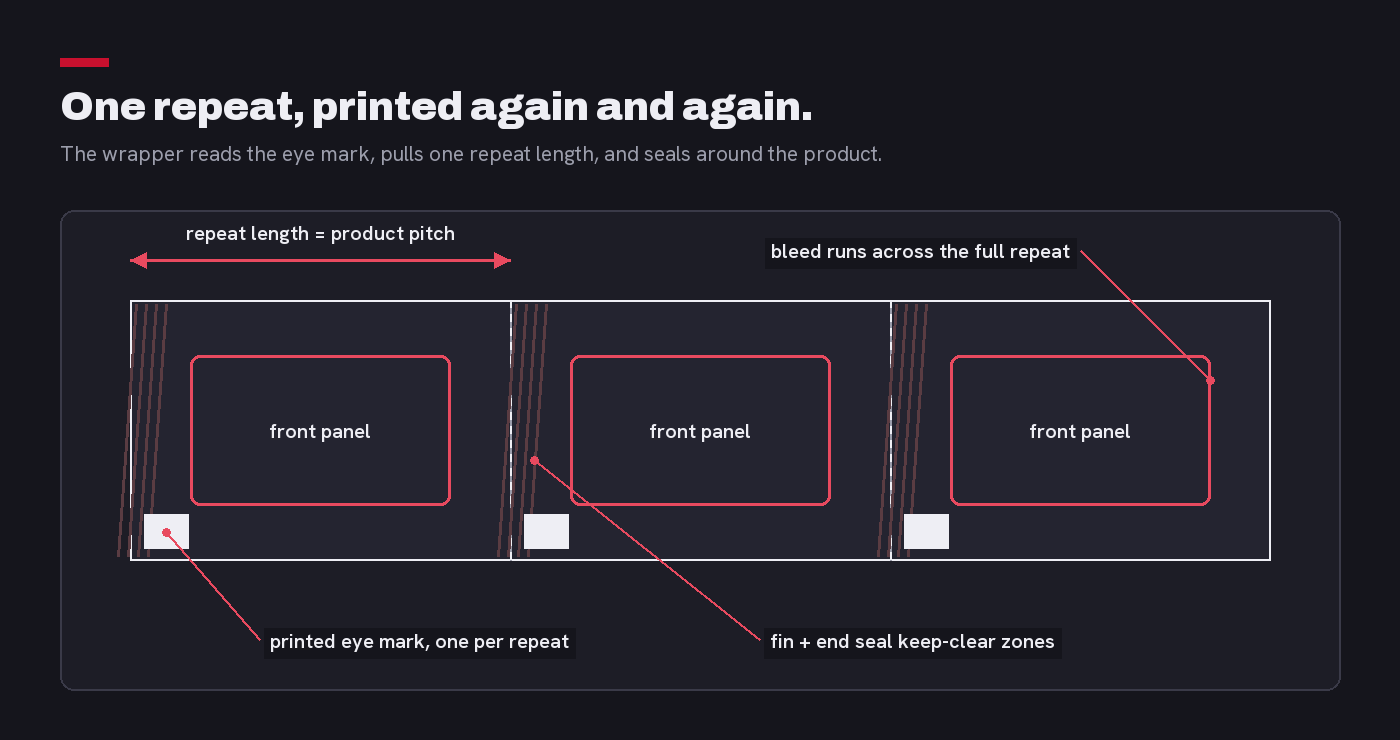
Every wrapper runs on a pitch: the distance the film advances for one product. The printed repeat has to match it exactly, because the design prints not once but thousands of times down a continuous web, one repeat per pack. If the repeat runs even half a millimeter long, the error accumulates down the roll and the cutoff drifts into your copy. We build repeat length from your machine's spec sheet, not from the dieline alone.
Registration is what keeps that from happening. Each repeat carries a printed eye mark, a small solid rectangle in a reserved lane along one film edge. The wrapper's photo sensor reads that mark every cycle and corrects the film feed, so the cut lands in the same place pack after pack. The mark needs real contrast against the film behind it, clean edges, and identical placement every repeat, which is a print job, and ours.
Unwind direction matters just as much. Rollstock can be wound print-side in or out, with copy leading head-first or foot-first off the roll; feed a wrapper the wrong one and graphics run upside down or the eye mark sits on the wrong edge. Before anything prints, prepress confirms unwind, core size, roll diameter, and the tolerances your line holds, then proofs the layout against those numbers.
Films, white underlay, and seal keep-clear zones.
The stock is heat-sealable film, most commonly polypropylene, chosen so the sealing jaws can fuse it to itself at the fin and both end crimps. We print it full color on G7-calibrated presses: white goes down first so brand color reads true on a translucent substrate that would otherwise wash it out wherever the product shows through. Color built on measured gray balance holds steady from the first roll to a reorder months later.
Seal zones are where artwork most often goes wrong. Wherever the jaws land, along the back fin and across both crimps, film has to fuse to film. Heavy ink coverage in those bands can interfere with the weld, and ink caught inside a crimp can flake or mottle under heat and pressure. So the layout reserves keep-clear bands at the fin and crimp ends, and dense coverage and must-read copy stay out of them.
Matte or gloss is a bigger decision on film than on a carton, because the finish comes from the substrate and the laminate themselves; film takes no coating pass. Gloss reads bright and wet, which suits candy and bakery. Matte cuts glare under store lighting and photographs cleaner, which is why protein bars and better-for-you snacks lean that way. We run both, laminate where a job needs stiffness or scuff resistance, and printed samples on the exact stock settle the choice faster than adjectives.
Artwork setup: one repeat unit, built to register.
You are not laying out a bag; you are laying out one repeat unit that tiles seamlessly down the web. The file is a single rectangle at the exact repeat length and web width, and every part of the finished pack, front panel, back panel, fin allowance, crimp bands, lives at a fixed position inside it. Get that one rectangle right and the whole roll is right.
Center the front panel between eye marks; that is the window shoppers see once the pack is cut, and a logo drifting toward a crimp reads as a mistake even when registration is perfect. Backgrounds must bleed across the repeat boundary so no seam flashes where one repeat meets the next. Hold type sizes honest, too: fine print that survives on a smooth label can break up on flexible film, so we flag anything below about six points.
Prepress checks every file against the wrapper's spec sheet before anything runs: repeat length against pitch, eye mark size and lane position against the sensor, keep-clear bands against the jaw locations, unwind against the feed path. Because short runs run on digital presses, there are no plates to amortize, which makes short runs on film a normal way to launch: print a few hundred packs of a new flavor, read the shelf, revise the art, and reorder.
The Flow Wrap Film Layout Spec Sheet
Repeat length, eye marks, seal keep-clears, the unwind chart and the prepress checklist, on two printable pages. It works alongside your wrapper's own film spec sheet.
Who uses this format, and for what.
The buyers of printed film fall into a recognizable pattern: high unit counts, small products, and a package that has to be sealed, branded, and cheap per unit. Some are consumer brands feeding their own wrapper; just as many are co-packers running film we print to a spec their client approved. The categories below cover most of what comes through the plant.
It is not the answer to everything. A product that needs to reclose, stand upright on a shelf, or hold a serious moisture barrier is usually better served by a custom stand-up pouch, and we will say so at the quote stage. Bring the product itself to the conversation and the format usually picks itself.
- Bakery. Individually wrapped cookies, brownies, and muffins that sell from a counter basket as easily as from a carton.
- Protein and snack bars. The defining flow wrap product: matte film, dense nutrition copy, and a repeat short enough to keep a dozen flavors in rotation.
- Candy and confections. Pillow packs for single pieces and for the components inside a larger multipack bag.
- Bar soap. A dry, stable product that mostly needs a crisp print job, clean crimps, and a finish that survives a bathroom shelf.
- Single-serve wellness items. Wipes, patches, and similar formats printed in an FDA-registered facility, with your regulatory advisor owning the final compliance call.
- Promotional kits. Short-run wrapped inserts, samples, and event pieces where a printed pack outclasses a plain poly bag.
See all six retail packaging formats
Flow wrap is one of six formats that run through the same prepress, color and finishing pipeline. The retail packaging page compares them, with a 3D sample table to spin.
Flow Wrap Packaging: questions, answered.
What products are best suited to flow wrap packaging?
The format favors small, uniform, fast-moving products: bars, baked goods, candy, soap, wipes, and multipack components. If the item is rigid or consistently shaped, feeds well on a conveyor, and sells in high counts, it wraps well. Products that need reclosability, standing shelf presence, or a heavy moisture barrier usually belong in a pouch or a carton instead.
What is the minimum order for flow wrap film?
A few hundred packs is a real order here. The film prints on digital presses with no plate charges, which suits launches, seasonal flavors, and test markets. Exact quantities depend on web width, repeat length, and film choice, so send the pack dimensions and we will quote the honest number.
Can you match film to our existing wrapper's spec?
Yes. Send the machine's film specification sheet, or the label from a roll that runs well, and prepress builds the layout to it: repeat length, web width, eye mark size and position, unwind direction, core diameter, and maximum roll diameter. If no spec sheet exists, a sample roll and a few measurements off the machine get us there.
Which films are available, and in what finishes?
Heat-sealable polypropylene in gloss or matte is the workhorse, printed full color and laminated when a job needs stiffness or scuff resistance. If your product is heat-sensitive or your line seals cold, raise it early: film choice is a three-way fit between product, wrapper, and print, and we spec it directly against your machine sheet.
Flow wrap or stand-up pouch: which is right for my product?
Choose flow wrap when the job is many small units sealed fast at the lowest film cost per pack: bars, singles, multipack components. Choose a stand-up pouch when one package has to live on a shelf for weeks: resealable, self-standing, with room for a wider barrier range. Plenty of brands run both, wrapped singles inside, a pouch as the retail face.
What is the difference between overwrap and flow wrap?
Overwrap folds film around an already-rigid item or carton and secures it with folded, tucked ends, the way a tea box is wrapped. Flow wrap forms film into a sealed tube around the product itself, with a fin seal and crimped ends, so the film is the primary package. No box underneath means the film does all the containing.
How should I set up an artwork file for flow wrap packaging?
Build one repeat unit at final size: a single rectangle matching the repeat length and web width on your machine sheet, front panel centered between eye marks, backgrounds bleeding across the repeat edge, and nothing critical inside the fin or crimp keep-clear bands. Vector logos, outlined or embedded fonts, CMYK color. Prepress checks the file against your wrapper spec before anything prints.
Part of the retail packaging family.
Every format here runs through the same prepress, color and finishing pipeline. Explore the rest:
Put real numbers on your project.
Send your wrapper's film spec sheet, or just the product and pack dimensions, and a production person will come back with film options and real pricing. No configurator, a conversation.