
Last updated: September 20, 2026
Two people can type the words “shrink label” into a search bar and want completely different things. One is a beverage brand trying to decorate a contoured bottle from shoulder to base. The other is trying to seal a pallet, a boat, or a stack of storage tubs. They end up on the same results page, reading the same articles, and the confusion costs the first person real time. If you are deciding how to decorate a container, the format you are looking for is almost certainly a shrink sleeve, and it has very little to do with the roll of clear film at the hardware store. The shrink sleeve labels page covers the format in production detail; this is the piece that sorts out which of the three options belongs on your container in the first place.
Three formats get compared here: the shrink sleeve, shrink wrap, and the ordinary pressure-sensitive label. They overlap in name and almost nowhere else.
Table of Contents
- The short version
- What is shrink sleeve labeling?
- What shrink wrap is, and why it keeps getting confused with sleeves
- When a pressure-sensitive label is still the right answer
- Can you print on shrink sleeves?
- What drives the cost of a shrink sleeve
- Tamper evidence: when the answer is a band, not a sleeve
- Side by side
- FAQ
The short version
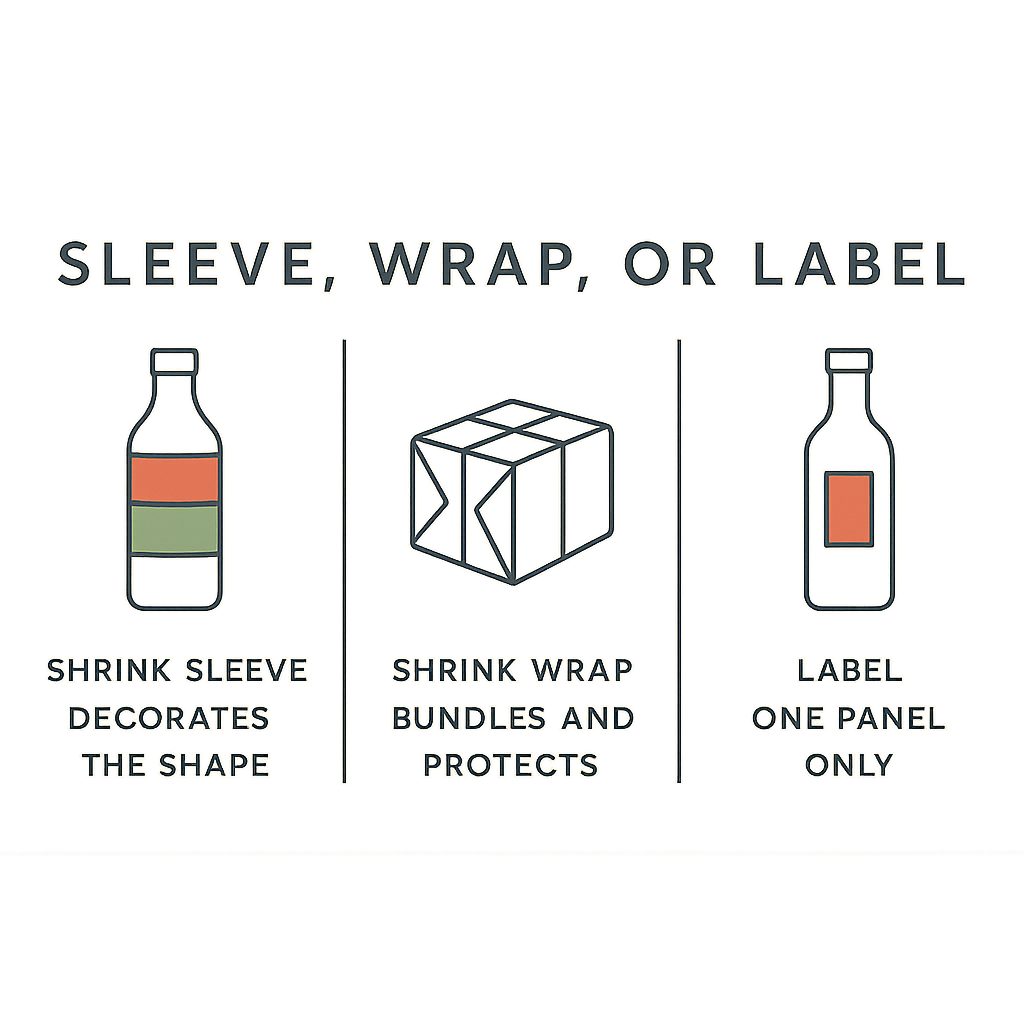
A shrink sleeve is printed film that shrinks tight to a container and becomes its decoration. Shrink wrap is unprinted or lightly printed film used to bundle and protect things. A pressure-sensitive label is an adhesive-backed label applied to one panel. Sleeve decorates, wrap protects, label identifies.
Almost every wrong turn in this category comes from the first two sharing a word. The heat behaves similarly, the raw material is film in both cases, and the trade names bleed into each other in everyday speech. The jobs do not overlap at all. A brand choosing between them is really choosing between decorating a shape and covering a shape, which is not a close call once it is stated plainly.
What is shrink sleeve labeling?
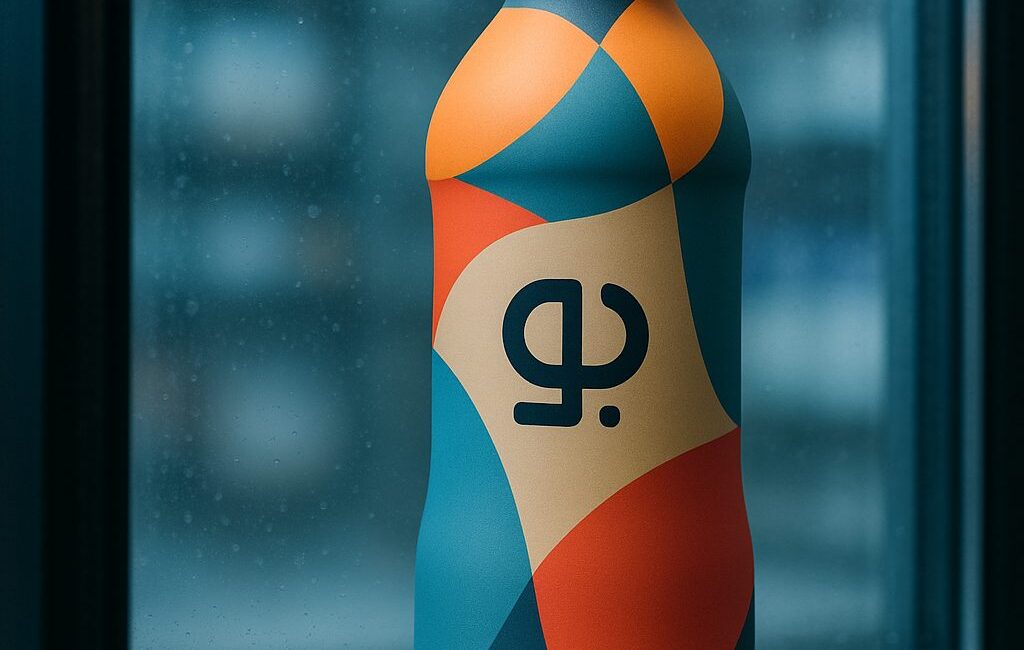
Shrink sleeve labeling is a printed film tube that is slipped over a container and passed through a heat tunnel, where it contracts to the container’s exact contour. The artwork ends up wrapped a full 360 degrees around the package, including the curves and the taper, with no visible edge or seam of adhesive.
That full-surface coverage is the whole point of the format. A shopper judges a curved bottle from the side, through a cooler door, in about two seconds. A sleeve hands the entire container to the artwork, so color and copy stay straight where a flat label would wrinkle, flag at the edges, or simply stop short of the shape. Anywhere a container narrows, flares, or has a waist, a sleeve is doing something no flat label can.
The format also lets the package change without the mold changing. A single stock bottle can carry ten different products, ten different colors, and ten different personalities, because the decoration is a printed film rather than a tooling decision. For brands running a family of flavors or strengths, that is often the reason the format gets chosen before anyone talks about shelf impact at all.
What shrink wrap is, and why it keeps getting confused with sleeves
Shrink wrap is a loose film that is placed around an item or a group of items and heated so it draws in and holds them together. Its job is containment and protection: multipacks, pallet loads, equipment covers, tamper deterrence on a shipping carton. It is a logistics material, not a decorating one.
The two get confused for an honest reason. Both involve film and heat, and in ordinary conversation “shrink wrap labels” is what plenty of buyers call sleeves. The trade name is shrink sleeve, and the sleeve is what is being described when someone says they want art that hugs a bottle.
The practical disadvantage of reaching for wrap when you wanted a sleeve is that wrap was never built to carry fine artwork. It is engineered for tear strength and load stability. Print on it is typically limited, registration is not the design goal, and it sits loosely rather than conforming to a contour, so type distorts unpredictably. If the deliverable is a package a shopper looks at, wrap is the wrong material, and no amount of care at the heat tunnel fixes that.
When a pressure-sensitive label is still the right answer
For a straight-sided container decorated on one panel, a pressure-sensitive label is usually cheaper, simpler, and entirely sufficient. If the bottle is a cylinder, the art lives on one face, and there is no tamper requirement built into the decoration, the flat label wins on cost and on how easily it runs.
Pressure-sensitive work also has a much shallower setup path. There is no distortion mapping, no heat tunnel to dial in, and no shrink percentage to design around. A file goes to a custom label press and comes back as labels on a roll. That simplicity matters most on a launch where the container is still changing, because a label revision costs a reprint and nothing else.
The decision generally tips to a sleeve when one of four things is true: the container is contoured in a way a flat label cannot follow, the design wants the whole surface, the package lives in ice chests and refrigerated cases where a label edge can lift, or tamper evidence needs to be part of the decoration itself. Short of those, a flat label is the sensible default.
Can you print on shrink sleeves?
Yes, and the printing is the easy half. The hard half is that the artwork has to be built distorted on purpose, so that it lands correct after the film contracts. Straight logos on a flat file come out bent on a contoured bottle unless the file was designed on the container’s own template.
Film choice sets how far the art can conform. PETG is the workhorse: high shrink capability, crisp print, good clarity. PVC still runs for cost-sensitive work, with less conforming range. In practice PETG will follow a contour needing shrink into the seventies, percentage-wise, which is why aggressively shaped bottles almost always end up on it.
Film choice is also a regulatory question on anything edible. A sleeve normally sits on the outside of a sealed container rather than against the food, but where film does contact a product, the polymers involved are governed as indirect food additives under 21 CFR Part 177, and the FDA’s food ingredients and packaging guidance is the plain-language entry point. It is worth confirming rather than assuming, particularly on tubs and cups where the decoration gets closer to the contents than it does on a bottle.
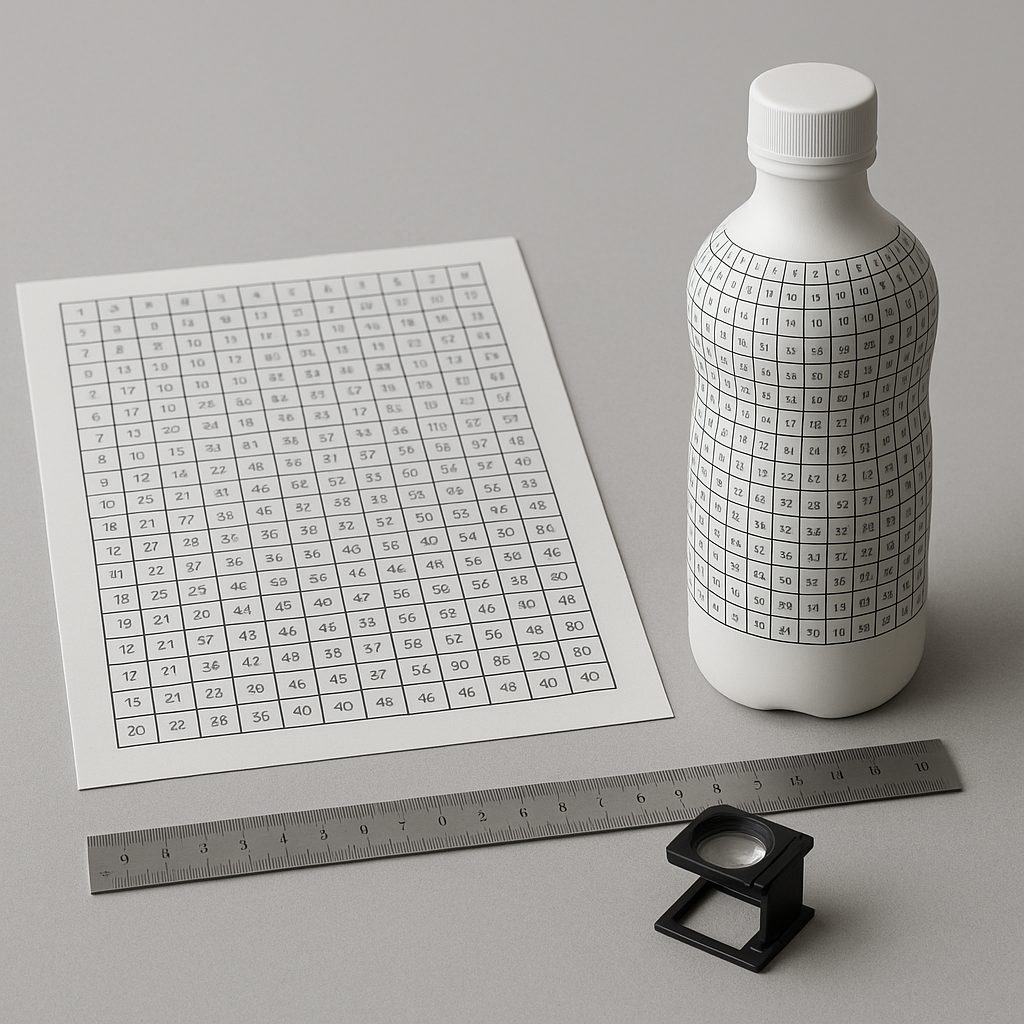
Distortion compensation starts with a physical test rather than a calculation. A printed grid sleeve goes onto the actual container and through the tunnel, and where each cell of the grid lands tells you exactly how much the film moves at every height on the shape. That map becomes the template the artwork is designed on. It is measured, not estimated, which is also why a sleeve project wants a real sample container in hand early.
The same shrink map decides where copy is allowed to live. Barcodes, legal text, and nutrition panels belong in the calmest band of the container, usually the straight section of the body. In curved zones, a barcode gets rotated so its bars run around the container rather than up it, because circumference change stretches a bar pattern in the direction that breaks scanning. GS1 US publishes the barcode quality expectations retailers hold suppliers to, and a sleeve that scans is not an accident of layout.
What drives the cost of a shrink sleeve
There is no single per-sleeve price, because the number moves on five things: how much film the container needs, which film it runs on, how long the run is, how many artwork versions ride that run, and whether the sleeve carries a tamper feature. Container size is usually the biggest single lever, since a tall contoured bottle simply consumes more film than a squat one.
Run length behaves differently depending on how the work is produced. Sleeves printed on digital presses carry no plate step, so a few hundred pieces is a workable run for sampling, a shelf test, or a limited flavor, which is far below what the format is usually assumed to require. That changes the economics of testing a design before committing to it.
Version count is the quiet cost saver. Because there is no plate to remake between versions, a family of eight flavors can often be produced across one run rather than eight setups. Brands that assume each SKU is a separate job are usually budgeting for a process they are not actually using.
Tamper evidence: when the answer is a band, not a sleeve
If the requirement is proof that a package has not been opened, and not full-container decoration, a shrink band is the cheaper and more direct answer. A band is a short sleeve that covers the neck, the cap, or the seam between them, and it tears on first opening.
Bands can carry print, so they are not purely functional. A neck band is a reasonable place for a seal graphic, a batch code, or a short brand mark, and it can be specified without committing the rest of the container to a sleeve. Plenty of packages run a pressure-sensitive body label and a printed band together, which gets tamper evidence onto the package without paying for full coverage.
Some containers need adhesive help. A tapered yogurt cup is the classic case: the shape works against the film, and those applications take a heat-activated adhesive as well as the shrink. That is a spec question worth raising early, because it changes the material set rather than just the artwork.
Side by side
| Shrink sleeve | Shrink wrap | Pressure-sensitive label | |
|---|---|---|---|
| Job | Decorate the container | Bundle and protect | Identify one panel |
| Coverage | Full 360 degrees | Around the outside of a load | One face or a partial wrap |
| Handles contours | Yes, that is the point | Loosely, without registration | Poorly, edges lift and flag |
| Artwork setup | Distorted to a measured template | Minimal | Flat file, no distortion |
| Tamper evidence | Built in, or as a separate band | Incidental | Requires a separate feature |
FAQ
What is the difference between a shrink sleeve and shrink wrap?
A shrink sleeve is printed film that becomes the container’s decoration, conforming tightly to its full shape. Shrink wrap is film used to bundle or protect items, with little or no artwork. Sleeve decorates one container; wrap contains one or more of them.
How much does a shrink sleeve label cost?
It depends on container size, film, run length, how many artwork versions run together, and whether a tamper feature is included. Container size moves the number most, because a larger container uses more film per piece. Sleeves produced on digital presses have no plate step, so short runs are workable and versions are inexpensive to add.
Can I print on shrink sleeves?
Yes. The artwork is printed on the flat film before it becomes a tube, and it has to be pre-distorted so it reads correctly after shrinking. That distortion comes from a printed grid sleeve run on the real container, which maps how the film moves at each height on the shape.
What are shrink sleeves used for?
Contoured bottles, cans, jars, tubs, and cups where the artwork should cover the whole container, where a flat label would wrinkle or lift, where the package lives in cold and wet conditions, or where tamper evidence needs to be part of the decoration.
Is a shrink sleeve worth it for a short run?
Often, yes. The format is widely assumed to require large volumes, but digital production removes the plate step, so a few hundred pieces is a practical run for a shelf test or a limited release before a full commitment.
Not sure which format your container wants?
If you have a container in hand and a design that has to sit on it, the fastest path is a real sample rather than a spec sheet. Request a quote from White Graphics with your container and artwork, or read how the format runs in production on the shrink sleeve labels page. Sleeves sit inside a wider family of film formats covered in the guide to flexible packaging, alongside stand-up pouches and flow wrap.
About the publisher
White Graphics is a G7 Master qualified custom label and packaging company managed out of Naperville, Illinois, serving food, beverage, supplement, cosmetic, and household-product brands across North America since 1972. Learn more about the company or see the full range of capabilities.