
Last updated: October 26, 2026
For most of the last century, cosmetic labeling in the United States changed very little. Then the Modernization of Cosmetics Regulation Act of 2022, known as MoCRA, became the largest expansion of the FDA’s authority over cosmetics since 1938. Some of its requirements are already in force and reach the label directly. Others are still waiting on FDA rulemaking, and at least one of those is likely to send brands back to press. This guide covers the FDA cosmetic label requirements as they stand in October 2026: what MoCRA added, what it left alone, what is still coming, and how to plan cosmetic labels so the next rule change costs a reprint of weeks of stock rather than a year of it.
The short version: every cosmetic label now needs a way for consumers to report adverse events, the long-standing ingredient and identity rules still apply in full, and fragrance allergen labeling is the change to plan for.
Table of Contents
- What is MoCRA?
- What MoCRA requirements are already in effect?
- FDA cosmetic label requirements, panel by panel
- The adverse event contact line
- What is still coming: fragrance allergens and more
- Does MoCRA apply to small brands?
- When a cosmetic label becomes a drug label
- Planning labels for a rule that is not final yet
- FAQ
What is MoCRA?
MoCRA is the federal law, signed on December 29, 2022, that gave the FDA new authority over cosmetics: mandatory adverse event reporting, facility registration, product listing, safety substantiation, records access and mandatory recall. It also added new label requirements and directed the FDA to write new rules on fragrance allergens, manufacturing practices and talc testing. The FDA’s MoCRA page tracks each provision.
MoCRA did not replace the existing cosmetic labeling rules under the Federal Food, Drug, and Cosmetic Act and the Fair Packaging and Labeling Act. It added to them. A label that was compliant before 2022 is not automatically compliant now, but nothing that was required before has gone away.
What MoCRA requirements are already in effect?
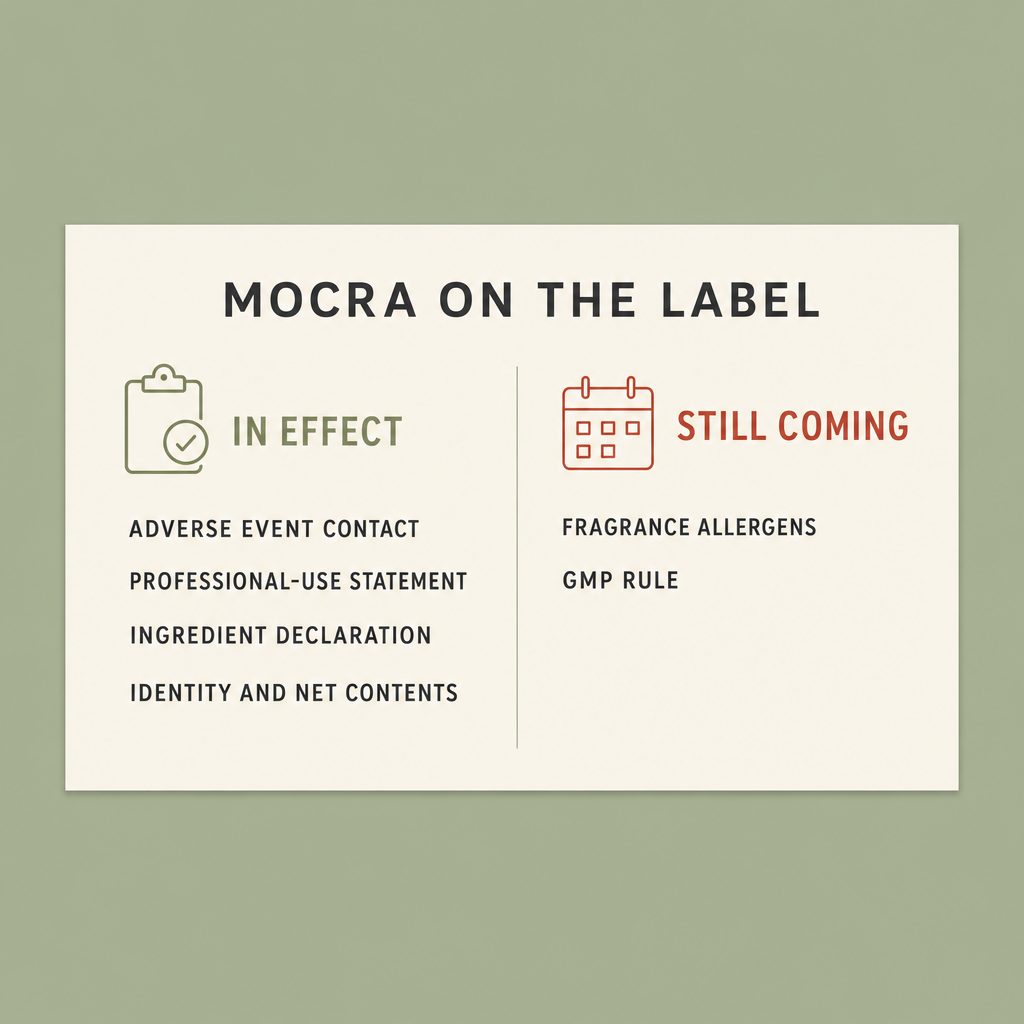
As of October 2026, these MoCRA obligations are in force:
- Serious adverse event reporting. The responsible person, meaning the manufacturer, packer or distributor whose name appears on the label, must report serious adverse events to the FDA within 15 business days, with a copy of the label.
- Facility registration and product listing. Facilities that manufacture or process cosmetics for the US market register with the FDA and renew every two years. Each product is listed, with its ingredients, and listings are updated annually.
- Safety substantiation. The responsible person must keep records supporting that each product is safe.
- Professional-use labeling. Products sold only to licensed professionals, such as salon color, must say plainly and prominently that they are to be used only by licensed professionals.
- Label contact information. Since December 29, 2024, every cosmetic label must carry a domestic address, a domestic phone number, or electronic contact information, such as a website, through which the responsible person can receive adverse event reports.
Two of those items change the printed label itself: the professional-use statement and the contact line. The rest live in filings and records, but they depend on the label being right, because the label is what the FDA receives with every adverse event report.
FDA cosmetic label requirements, panel by panel
Under the long-standing rules, which MoCRA left in place, a cosmetic label is organized around the principal display panel, the part of the package most likely to face the shopper, and an information panel for everything else.
- Statement of identity, on the principal display panel: what the product is, in plain terms such as “facial moisturizer” or “shampoo.”
- Net quantity of contents, also on the principal display panel, in the lower 30 percent of the panel, in both US customary and metric units.
- Ingredient declaration, in descending order of predominance, using the names the FDA’s regulations specify, which largely follow the INCI naming convention. Ingredients at 1 percent or less, and color additives, may follow in any order.
- Name and place of business of the manufacturer, packer or distributor, with “Manufactured for” or “Distributed by” wording when the company named is not the manufacturer.
- Warnings where the product category requires them, such as aerosols, set conspicuously.
- The MoCRA additions: the adverse event contact line on every product and, where it applies, the professional-use statement.
On small components, the ingredient list is the hard part. A dropper bottle or a lip balm tube does not have much surface, and the declaration has to stay legible rather than technically present. Accepted solutions include a wrap that extends the panel area, a booklet (peel-back) label that opens to reveal more copy, and placing the declaration on the outer carton when the product is sold in one. White Graphics checks minimum type sizes and stroke weights on tiny ingredient lists in prepress and recommends the right approach for the component. The full rulebook is in the FDA’s Cosmetics Labeling Guide.
The adverse event contact line
The contact requirement is the MoCRA change most likely to be missing from a label printed before 2025. It is easy to satisfy, but it has to be deliberate. The contact information has to reach the responsible person, it has to be domestic if it is an address or phone number, and it has to be something the company actually monitors, because reports that come in through it start a 15-business-day clock for serious events.
A website address satisfies this requirement, which is why many brands use a dedicated page or form. The separate name and place of business line is different: it still needs a street address, and a website does not satisfy it. If the brand’s main domain changes, the label is now part of that change. Brands with existing stock that predates the requirement have two practical options: reprint, or apply a small cover-up label carrying the contact line to packaging that is already filled.
What is still coming: fragrance allergens and more
Three MoCRA rules were due from the FDA and have not been finalized:
- Fragrance allergen labeling. MoCRA directs the FDA to identify fragrance allergens that must be named on the label. Today, fragrance can be declared simply as “fragrance.” The statutory deadline for the proposed rule passed in 2024, and as of this writing the FDA has not published it or given a firm date.
- Good manufacturing practices. A GMP rule for cosmetic facilities was also due and has not been issued as a final rule.
- Talc testing. The FDA proposed standardized asbestos testing methods for talc-containing cosmetics in December 2024, then withdrew the proposal in November 2025.
For the label, fragrance allergens are the one that matters. When the rule arrives, brands whose formulas contain listed allergens above whatever threshold the rule sets will need to name them on the label, and that is a reprint for every affected SKU. Final rules usually include a compliance period, so this is a planning problem, not an emergency. It does argue against stocking a year or more of labels for scented products right now.
Does MoCRA apply to small brands?
Partly. MoCRA exempts certain small businesses, generally those with average annual US cosmetic sales under $1 million, adjusted for inflation, from facility registration, product listing and the coming GMP rule. The exemption does not cover labeling, adverse event reporting or safety substantiation, so the contact line applies to an indie brand exactly as it applies to a multinational. It also does not apply to some higher-risk product types, such as products that contact the eye, are injected, are meant for internal use, or alter appearance for more than 24 hours. The FDA’s small business fact sheet covers the details.
For a founder-led launch, the practical takeaway is that the label has to be complete from the first run, even when the filings do not apply yet.
When a cosmetic label becomes a drug label
The FDA classifies a product by its intended use, and the label is the main evidence of intended use. A moisturizer that “hydrates” is a cosmetic. A moisturizer that “treats eczema” is making a drug claim. A product with SPF, an antiperspirant, an anti-dandruff shampoo or an acne treatment is an over-the-counter drug, or both a drug and a cosmetic, and carries a Drug Facts panel with its own format.
The most common problem is not the product but the copy. Marketing language written for a website or a social post drifts into treatment claims when it is pasted onto a label. Flagging language that changes a product’s regulatory identity is part of a careful prepress review; the final call belongs to the brand’s regulatory advisor. Neighboring categories share the same trap, including bath and body, lip balm and perfume labels.
Planning labels for a rule that is not final yet
Regulatory change is a label inventory problem. The brands that absorb it cheaply are the ones that never hold more labels than they need.
- Order to the selling window. Digital short runs make it practical to print labels in quantities matched to production batches, so a rule change strands weeks of stock rather than a year of it. The economics are covered in short-run packaging.
- Keep panels editable. Artwork with the ingredient list and contact line as live type, not outlined or flattened, makes a revision a quick prepress change.
- Run versions together. With no plates to remake between designs, a dozen SKUs that each need a new ingredient line can ride one run instead of a dozen setups.
- Hold color across the reprint. A reprinted SKU that comes back a shade warmer than its neighbors breaks the shelf set. G7 Master qualified color management keeps a reprint matching the original and the rest of the line, which is the whole point of brand color consistency.
On the material side, a cosmetic label has to survive the product it describes. Oils and creams end up on the outside of the container, so the label needs a sealed film or laminate surface and an adhesive chosen for the component, whether glass, PET or a coated tube, so a reprint wears as well as it prints. A printed prototype on the real component confirms fit and legibility before the full run.
FAQ
What does MoCRA require on a cosmetic label?
MoCRA added a domestic address, domestic phone number, or electronic contact such as a website through which the responsible person can receive adverse event reports, required on labels since December 29, 2024. Products for licensed professionals only must also say so plainly. All earlier labeling rules still apply.
What are the FDA cosmetic label requirements?
A statement of identity and net contents on the principal display panel, an ingredient declaration in descending order of predominance, the name and place of business of the manufacturer, packer or distributor, any required warnings, and the MoCRA adverse event contact line. Professional-only products add a professional-use statement.
Do small cosmetic brands have to follow MoCRA?
Yes for labeling. Small businesses with average annual US cosmetic sales under about $1 million are exempt from registration, listing and the coming GMP rule, but not from label requirements, adverse event reporting or safety substantiation. Some higher-risk products, such as eyeliner and other products that contact the eye, are never exempt.
Is fragrance allergen labeling required yet?
Not as of October 2026. MoCRA requires the FDA to issue a rule naming fragrance allergens that must be disclosed, but the proposed rule has not been published. Until it is final and its compliance date arrives, fragrance can still be declared as “fragrance.” Plan label inventory with a future reprint in mind.
Can I fix old cosmetic packaging that lacks the contact line?
Yes. For packaging that is already filled, a small cover-up label can add the adverse event contact information without discarding stock. For future runs, reprinting with the contact line in the artwork is cleaner. Short runs keep the amount of label stock exposed to any later change small.
Get cosmetic labels built for the current rules
Send the component list, the artwork and the ingredient declaration, and request a quote from White Graphics; small-type legibility gets checked before the quote comes back. Formats and materials are on the cosmetic product labels page, and every other category is in the custom label catalog.
About the publisher
White Graphics is a G7 Master qualified custom label and packaging company managed out of Naperville, Illinois, serving food, beverage, supplement, cosmetic, and household-product brands across North America since 1972. Learn more about the company or see the full range of capabilities.