
Last updated: July 7, 2026
Every ad you’ve ever made can be skipped. Scrolled past, blocked, muted, closed after five seconds, or simply ignored by a brain that learned to tune out banners a decade ago. There is exactly one place left where a brand can put a message directly in a buying customer’s path and the customer can’t swipe it away: the store. An endcap, a floor display, a standee at the end of an aisle — these are the last unskippable ads in retail, and the brands that figured that out are quietly pouring money back into the physical shelf. If your brand only lives on a screen, you’re competing for the most contested, least trusted attention there is.
This is a look at why retail turned back into a media channel, why direct-to-consumer brands are buying shelf space they once swore off, and what actually makes a point-of-purchase display earn its footprint.
Table of Contents
- The last unskippable ad
- Why the store became a media channel again
- Why DTC brands are buying shelf space
- A display has one job: stop the cart
- Corrugated is the unsung hero
- The logistics nobody mentions
- How to brief a display that performs
- FAQ
The last unskippable ad
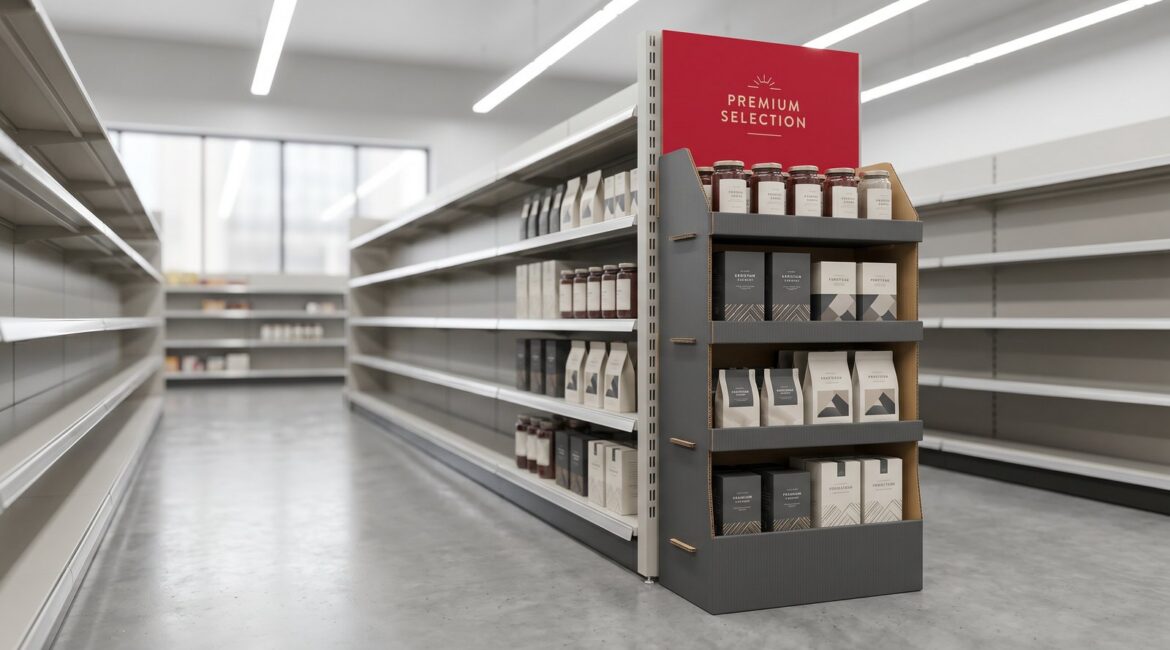
A retail display is the only advertising medium a shopper can’t fast-forward, because it occupies physical space in the path between them and the thing they came to buy. There’s no “skip ad” button on an endcap. There’s no ad blocker for a floor stand. The shopper is already in a buying mindset, already holding a basket, already spending — and your message is standing in the aisle wearing your brand colors. That’s a fundamentally different transaction than interrupting someone’s feed and hoping for a half-second of tolerance.
This is why the in-store moment keeps outperforming its reputation. Digital impressions are cheap and forgettable; a display impression happens at the exact moment of decision, to a person who is physically present and intent on purchasing. The medium everyone treated as old-fashioned turns out to be sitting on the most valuable real estate in marketing: the few feet of floor where intention becomes a transaction.
Why the store became a media channel again
Retail is a media channel because that’s where the shopping still is. For all the noise about everything moving online, the overwhelming majority of U.S. retail sales still happen in physical stores — e-commerce remains a minority slice of the total, according to the U.S. Census Bureau’s quarterly retail e-commerce report. The aisle never stopped being where the money changes hands. It just stopped getting credit for it while everyone watched the dashboards.
Retailers noticed before the brands did, which is why “retail media” became one of the fastest-growing categories in all of advertising — they’re selling access to the shopper they already have. In-store displays are the physical edge of that same idea: paid, branded presence at the point of decision. The store isn’t a logistics endpoint that happens to sell things. It’s a media property, and the display is your placement.
Why DTC brands are buying shelf space
The direct-to-consumer brands that built their identity on “we skipped retail” have, almost universally, walked it back — because acquiring a customer through digital ads got brutally expensive and physical retail turned out to be one of the most efficient ways to reach scale. You can’t grow forever on rising ad costs and a single channel. The shelf is where the next million customers actually are, and they’re cheaper to reach there than in an auction for their attention online.
But a brand born online has a specific problem when it lands in a store: it has never had to win a shopper who isn’t already searching for it. On a shelf, you’re an unknown next to incumbents, and a display is how a newcomer buys the visibility it can’t yet command from placement alone. A well-built floor stand or endcap gives a challenger brand the one thing the shelf won’t hand out for free — a reason for a passing cart to stop. Pairing that display with consistent brand color across the product and the display is what makes a new brand read as established instead of improvised.
A display has one job: stop the cart
A point-of-purchase display succeeds or fails on one metric: does it interrupt a moving shopper long enough to create a consideration that wasn’t going to happen otherwise. Everything else — the structure, the graphics, the copy — is in service of that single job. A display that’s beautiful but invisible at aisle speed is a failure with good production values.
That means the design rules are different from a package you hold at arm’s length. The hierarchy has to read from across the aisle: one dominant message, brand color doing the heavy lifting, and a structure that catches the eye in peripheral vision before the shopper has consciously decided to look. The most common failure isn’t ugliness — it’s politeness. Displays designed by committee tend to whisper six things instead of shouting one, and a whisper doesn’t stop a cart. Decide what the display is for, build everything around that, and let a physical prototype tell you whether it actually reads at distance before you commit to the run.
Corrugated is the unsung hero
Most of the displays that do this work are corrugated, and that’s a feature, not a budget compromise. Corrugated board is light enough to ship flat, strong enough to hold product, cheap enough to deploy at scale, fast enough to turn around for a seasonal window, and — not incidentally — one of the most widely recovered packaging materials in the country, per the EPA’s packaging recovery data. A display that does its job for six weeks and then gets recycled is a far easier sustainability story than a permanent fixture nobody wanted to throw away.
The craft is in making corrugated not look like corrugated. High-quality print across corrugated displays, retail signage, standees, and floor graphics is what turns a cardboard structure into something that reads as a premium brand statement under store lighting. The structural engineering — how it folds flat, how it assembles in seconds, how it holds weight without sagging by week three — is the part shoppers never see and store associates never forgive when it’s done badly.
The logistics nobody mentions
A display’s hardest problems happen after it’s designed, in the unglamorous space between your approval and an associate setting it up in a store a thousand miles away. It has to ship flat without damage, arrive with every component, assemble fast enough that a busy store actually bothers, and stand up to handling. A gorgeous display that arrives as a confusing pile of parts gets shoved in a back room, and your placement money evaporates.
This is why display programs live or die on fulfillment. Pre-kitting each display with its components, palletizing for the right distribution pattern, and shipping store-ready turns a logistics headache into a non-event. When the same operation prints the display and handles the pick-pack-and-ship, the program stays coordinated instead of fragmenting across vendors who each blame the other when a shipment shows up short. The display you designed is only as good as the one that actually gets stood up on the floor.
How to brief a display that performs
A good display brief starts from the job and works backward. Before you commission one, get clear on this:
- Name the single job. Launch a new SKU? Drive a promotion? Own a seasonal moment? One job per display.
- Define where it lives. Endcap, floor stand, counter unit, and shelf-edge are different design problems with different sightlines.
- Design for aisle speed. One dominant message readable from across the aisle, brand color carrying recognition before copy.
- Match the product exactly. The display and the package should read as one brand — same color, same world.
- Prototype before the run. Stand a physical sample up and look at it from twenty feet. Photos lie about scale.
- Plan the last mile. Flat-pack, kitting, assembly time, and store-ready shipping are part of the design, not an afterthought.
For brands thinking about how displays fit alongside their retail packaging as one coordinated presence, that coordination is the entire advantage of keeping it with a single partner.
FAQ
Are in-store displays still worth it when everything is going digital?
Yes — arguably more than ever. The majority of retail sales still happen in physical stores, and a display reaches a shopper at the moment of decision, in a buying mindset, with no way to skip the message. As digital ad costs rise and attention fragments, the unskippable in-aisle moment has gotten more valuable, not less.
Why are corrugated displays so common?
Corrugated ships flat, assembles fast, holds product, scales affordably, turns around quickly for seasonal windows, and is one of the most widely recycled packaging materials. With high-quality printing it reads as a premium brand statement, which is why it’s the default structure for most point-of-purchase work.
What makes a retail display actually work?
One job and aisle-speed legibility. A display has to interrupt a moving shopper, so it needs a single dominant message readable from across the aisle, with brand color doing the recognition work before any copy is read. Displays fail more often from being polite and saying six things than from being ugly.
Why does fulfillment matter for a display program?
Because a display only earns its placement money if it actually gets set up. It has to ship flat without damage, arrive complete, and assemble fast enough that a busy store bothers. Pre-kitting and store-ready shipping — ideally from the same partner that printed it — keep the program from fragmenting and stranding displays in back rooms.
Want a display that stops the cart?
If you’re putting a brand on a physical shelf and want a display built to perform — and to actually arrive store-ready — it’s worth a conversation. Contact White Graphics to talk through a display program, or start a request through the shop.
About the publisher
White Graphics is a custom label, packaging, and point-of-purchase display company in Naperville, Illinois, serving food, beverage, supplement, cosmetic, and household-product brands across North America since 1972. Learn more about the company or see the full range of capabilities.
Related reading: Sales samples that win the retail placement · prototyping a display before the full run
