
Last updated: July 7, 2026
Search “packaging mockup” (or “packaging mock up,” the space changes nothing) and you get template libraries: smart-object files, drag-and-drop generators, an endless scroll of the same floating pouch. Useful, until a retail buyer says “Love it, send samples,” and the screen stops being enough. Suddenly it matters that “mockup” is one word doing the work of four different objects.
First, the distinction that matters. A packaging mockup is a visual stand-in, digital or hand-built, that shows how a package will look. A packaging prototype is a physical unit produced with the same materials and processes as the production run, dimensionally and visually true to the final package. Mockups communicate design intent; prototypes verify it. We build both, CGI renderings and physical prototypes alike, so here is the even-handed ladder: what each rung is for, what it cannot tell you, and when it is enough.
Table of Contents
- One word, four objects: the packaging fidelity ladder
- Rung 1: Digital mockups and CGI renders
- Rung 2: The physical mockup, better known as the comp
- Rung 3: The prototype: production materials, production process
- Rung 4: The sales sample: prototype quality at selling quantity
- The expensive mistake: approving production from a screen
- Which one do you need? A short decision guide
- FAQ
One word, four objects: the packaging fidelity ladder
Packaging pre-production runs on a four-rung fidelity ladder: the digital mockup, the physical mockup (the comp), the prototype, and the sales sample. Each rung is more real than the last, costs more, and answers questions the rungs below physically cannot.
Most mockup vs prototype confusion comes from treating this as a two-way choice. The real skill is matching the rung to the decision; most packaging regret is a top-rung question answered with a bottom-rung object. The full production-side playbook lives in our prototype packaging guide.
Rung 1: Digital mockups and CGI renders
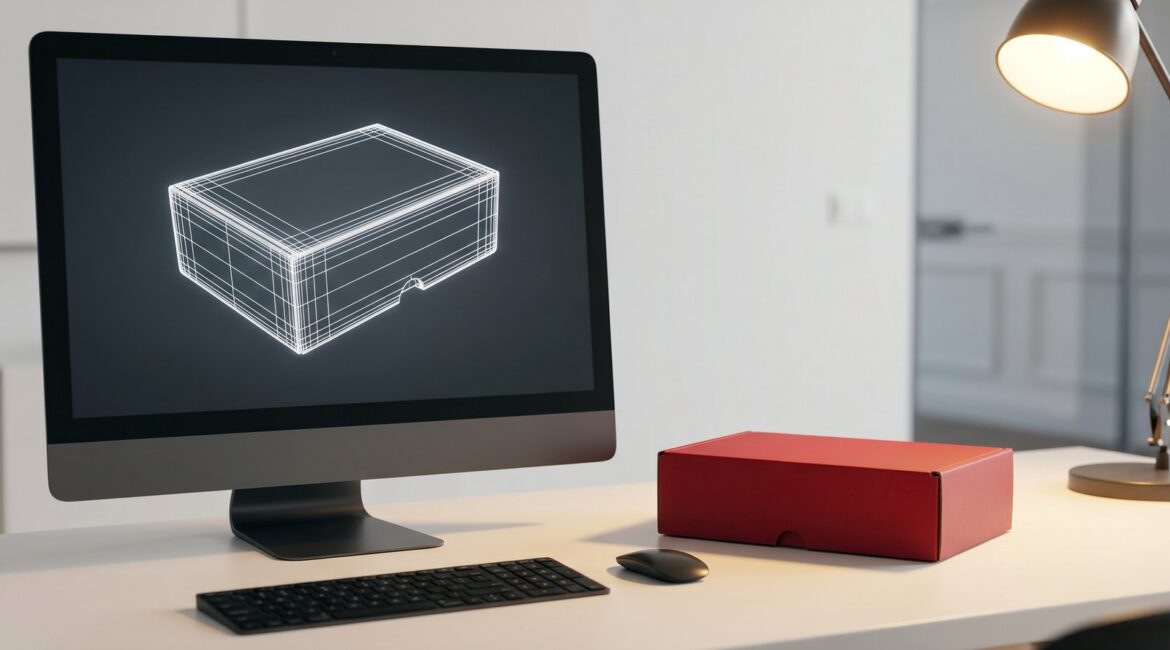
A digital packaging mockup is an on-screen visualization: artwork wrapped onto a 3D model or dropped into a photographed template. It is the fastest, cheapest way to see a design in context, and at the concept stage speed is exactly what you want.
Use it to compare directions, align stakeholders, and create imagery for products that do not exist yet. Free mockup template tools are perfectly respectable for early concepting. The serious end is CGI: photorealistic renderings polished enough to carry e-commerce listings before a single unit is made. We build those as part of packaging development; a good render settles which-direction arguments in an afternoon.
What a digital mockup cannot tell you is anything your hands would. Screen color is emitted light; package color is reflected ink on a real surface, and they routinely disagree. A render has no weight, no texture, no board stiffness, no proof your ingredient legend reads at arm’s length. Enough to choose a direction; not enough to approve anything physical.
Rung 2: The physical mockup, better known as the comp
A packaging comp (short for “comprehensive”) is a hand-built physical mockup: a look-alike built to be held, shelved, and photographed. It is the first rung you can hand to someone.
A physical packaging mockup earns its keep in form reviews. Does the carton feel right in hand? Does the pouch stand? Does the design hold up beside its shelf neighbors at real distance, under real lighting? Comps answer them early and cheaply.
The catch is how comps get made: printed on whatever device is convenient, mounted on whatever board is available, because the job is to look right, not to be right. The color is not production color, the substrate is not the production substrate, and the folds only imitate the converted package, so a comp can pass a shelf review while hiding a carton that cracks at the score or a film that mutes your brand color. Treat it as a form study and it serves you well.
Rung 3: The prototype: production materials, production process
A packaging prototype is produced with the same materials and the same processes as the production run, which makes it the first object on the ladder you can responsibly approve production against. Not a look-alike; the package, in quantity one.
Here is what “same materials, same processes” means in practice. Prototypes run on production-grade digital presses, with food-safe toners, on real substrates: pressure-sensitive label stock in gloss, matte, and specialty finishes; SBS, kraft, and recycled cartonboard; corrugated; flexible films; shrink sleeve films. Laser cutters and digital cutting tables handle the converting, assembly is handled on the same job ticket, and turnaround typically runs within a week — consultation and file prep, then production and assembly, then quality control and delivery. The machinery tour lives in our prototyping tech, tools, and process.
What a prototype cannot tell you is whether the product will sell. It verifies color, fit, readability, material behavior, shelf presence. One perfect unit will not cover a buyer meeting; that job belongs one rung up.
Rung 4: The sales sample: prototype quality at selling quantity
A sales sample is a prototype-grade unit produced in enough quantity to sell with: same materials, same processes, same dimensional truth, different audience. A prototype earns your approval. Sales samples earn everyone else’s.
This is the rung the retail buyer was asking for. Category managers judge packaging in hand; a finished sample answers what no deck can: feel, opening, how the finish reads under store lighting. Working quantities run 25-100 finished units for retail buyer presentations, 100-500 for a trade show, 10-25 for investor meetings. PR and creator mailers sit in the same family; we cover them in sales samples and influencer kits.
What a sales sample cannot do is rescue an unverified design. Produce samples after prototype sign-off, not instead of it, or you are multiplying a mistake for the audience you needed to impress.
The expensive mistake: approving production from a screen
The most reliable way to buy a packaging disaster is approving a production run from a rendering or a comp. Four things shift between screen and shelf: color, fit, readability, and material behavior.
Color shifts because monitors emit light and packaging reflects it; a screen shows saturation no ink on kraft will ever reach. Managing that translation is why G7 methodology exists and why Idealliance certifies printers against it. Fit shifts when a dieline that closed in CAD meets real board caliper, real tolerances, and real glue. Readability shifts because type that filled a monitor has to survive arm’s length in an aisle; regulated panels like the FDA’s Nutrition Facts label do not care how the deck looked. And materials have opinions: kraft drinks ink, textured stock changes personality under store lighting, shrink sleeves distort artwork as they conform.
None of this argues against digital tools; it argues for sequence. Start digital, finish physical: concept on screen, where iteration is nearly free, then verify on production materials before anyone signs a purchase order. Brands that get burned did not fail by using renders. They failed by stopping there.
Which one do you need? A short decision guide
Match the rung to the decision, not the deadline. In practice:
- Choosing between design directions: digital mockups and renders. Free templates are fine this early; move to CGI when the imagery has to persuade someone outside the building.
- Reviewing form or shelf presence internally: a comp, or better, a 10-25 unit prototype run so the review reflects real materials.
- Approving a production run: a prototype, full stop. It catches color, fit, and readability problems while they are cheap to fix.
- Presenting to a retail buyer: 25-100 finished sales samples. Buyers judge the package in hand whether you planned for it or not.
- Working a trade show: 100-500 units, so serious conversations end with your package in someone’s bag.
- Pitching investors: 10-25 units. A physical package makes a product story concrete faster than any slide.
The usual objection is time. Prototypes typically run within a week, with in-person pickup an option for Chicago-area teams and overnight shipping available nationally: less calendar than another round of stakeholder comments on a render.
FAQ
What is the difference between a packaging mockup and a prototype?
A mockup shows how a package will look; digital or a hand-built comp, it rarely uses production materials. A prototype is produced with the same materials and processes as the production run, making it dimensionally and visually accurate. Approve concepts from mockups. Approve production only from a prototype.
Are digital packaging mockups enough before production?
No. Digital mockups are excellent for comparing design directions and e-commerce imagery, but a screen cannot show printed color, material texture, weight, structural fit, or how type reads at actual size. Before approving a production run, review a physical prototype built with production materials.
What is a packaging comp?
A comp, short for comprehensive, is a hand-built physical packaging mockup showing form and graphics without necessarily using production materials or printing. Comps work for internal form and shelf reviews, but they imitate the finished package rather than reproduce it, so they are not a reliable basis for approving color or production.
When do I need a physical packaging prototype?
Before approving a production run, before a retail buyer presentation, and before photography or investor meetings where the package represents the product. If the decision depends on color accuracy, structural fit, readability at size, or how the package feels in hand, a rendering cannot answer it. A prototype can.
Need the real thing in someone’s hands?
If the next meeting needs more than a render, we build production-true prototypes and sales samples on turnarounds that typically run within a week, and quotes can often come back within a business day. Contact White Graphics to scope your project, or start a request through the label shop.
About the publisher
White Graphics is a G7 Master–qualified prototype packaging and custom label company in Naperville, Illinois (Chicago metro), serving food, beverage, supplement, cosmetic, and household-product brands across North America since 1972. Learn more about the company or see the full range of capabilities.