
Last updated: May 12, 2026
The custom label and packaging printing industry has spent the last 18 months integrating AI into specific stages of production — not in the press-release sense, but in the day-to-day workflow software that runs across prepress, color management, press operations, and finishing. This guide is an industry-side look at where AI lives inside a modern custom label printing workflow in 2026, which vendors are driving it, and what brand customers should understand about how it changes the production stack.
The framing here is observational. Different printers are at different points on the adoption curve, and the AI layer mostly sits on top of established workflow platforms from a handful of major industry vendors. Knowing which vendors and which stages matters when evaluating a printing partner. For the parallel question of which short-run printers are moving fastest, see the companion piece on how short-run label and packaging printers are implementing AI in 2026.
Table of Contents
- Why custom label printing is a tough AI integration problem
- AI in prepress: where most of the industry has invested first
- AI-assisted color management
- AI in variable data and serialized printing
- AI mockup generation
- AI on the press floor: predictive maintenance
- AI-driven inspection and quality control
- AI in quoting, estimating, and scheduling
- What stays human across the industry
- What this means for brand customers
- FAQ
Why custom label printing is a tough AI integration problem
Custom label printing has structural characteristics that make AI integration harder than in, say, large-format commercial print or trade book printing. Short runs (often under 5,000 labels per job) leave little setup time to amortize across. Every job has unique die specs, substrate selection, color requirements, and regulatory copy constraints. Variable data jobs add a layer of unique-per-label data verification. And final approval responsibility — color sign-off, regulatory copy verification — still sits squarely with humans for legal and brand-quality reasons.
The result: AI in custom label printing isn’t replacing entire roles. It’s automating high-volume repetitive judgment tasks at each stage of the workflow, leaving senior human review at the critical gates. That’s the pattern across the industry in 2026.
AI in prepress: where most of the industry has invested first
Prepress is where AI has had the highest immediate ROI for custom label printers, and where most of the industry’s adoption is concentrated. The dominant prepress workflow platforms — Esko’s WebCenter and ArtPro+, Hybrid Software’s CLOUDFLOW, and OneVision Software — have all integrated AI-assisted preflight, automated artwork QC, and intelligent prepress automation modules over the past two years.
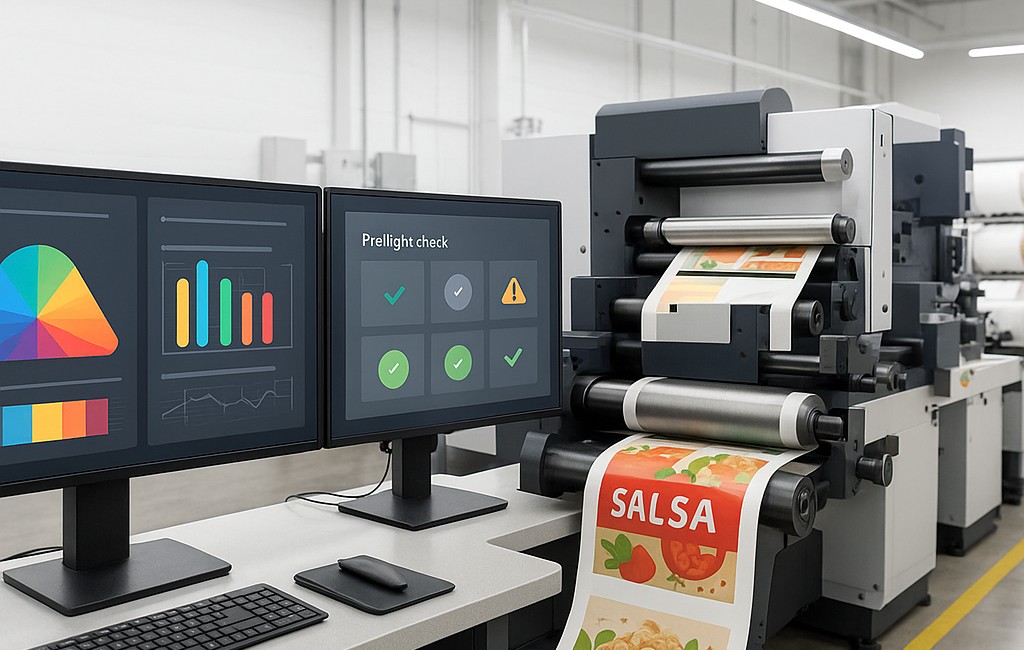
The practical effect at the per-job level: customer files arrive in dozens of formats and conditions. Automated preflight now handles the first-pass triage in minutes — type integrity, color mode, image resolution, bleed compliance, regulatory copy completeness flags, and die line verification. What used to be a 30-to-60-minute manual review by a prepress technician on every file is now a 5-to-10-minute review of an AI-generated flag report.
For an example of how this layers with human prepress signoff at a real production shop, see this quality control process overview.
AI-assisted color management
Color is the single biggest pain point between brand customers and printers, and it’s where ML-driven color prediction tools are gaining the most traction in 2026. GMG Color is one of the long-established players in this space, with their OpenColor and ColorProof products increasingly integrating ML-based color profiling. Esko’s Equinox extended-gamut printing system uses algorithmic ink optimization that’s effectively a form of applied AI for color separation.
What this means at the production level: a brand’s submitted file can be evaluated against the specific press and substrate profiles being used, and the actual printed-color result can be predicted before any substrate is consumed. Brand-side designers see an accurate proof-on-screen experience, which dramatically reduces the “but it didn’t look like that on my monitor” cycle.
This sits on top of foundational color-management methodology like G7 from Idealliance and ISO 12647 process control. AI doesn’t replace the foundation — it makes the foundation faster to apply per job. For the foundational why, see this G7 explanation for brands.
AI in variable data and serialized printing
Variable data printing — where every label in a run carries unique data (lot codes, batch numbers, serialized QR codes, personalization variables) — has been a technical capability for over a decade. What’s new in 2026 is AI-driven verification of the variable data merge at scale. Industry platforms like Esko’s Dynamic Marks and ProductionLine, and Hybrid Software’s prepress automation tooling now flag data anomalies, format mismatches, and verification failures during the prepress data merge — before any substrate hits the press.
This matters because variable data labels increasingly connect to traceability and compliance systems: FSMA Section 204 for food, MoCRA for cosmetics, GS1 SunRise 2D barcodes for retail-bound CPG packaging. A failed variable data run isn’t just wasted material — it’s a compliance and reorder cycle that can take weeks.
Modern variable label printing services across the industry are increasingly being built around this AI verification layer.
AI mockup generation
For early-stage stakeholder review, retailer buyer presentations, and ecommerce thumbnail use, AI-driven 3D mockup tools have largely replaced the older workflow of either expensive 3D rendering engagements or physical printed samples. Tools like Smartmockups, Placeit, and various KeyShot AI extensions wrap flat artwork around 3D product models in minutes.
For final buyer presentations and final brand approvals, physical printed prototypes still hold their place — there’s no substitute for handing a buyer a real printed label on real substrate. Most full-service printers continue to offer packaging development and rapid prototyping services for that step.
AI on the press floor: predictive maintenance
Modern digital and flexo presses are heavily instrumented. HP Indigo digital presses, Heidelberg’s Prinect platform, and digital label-press OEMs like Domino, Mark Andy, and Xeikon all now offer connected-press data platforms that feed sensor data — vibration, temperature, ink-system pressure, substrate tension, registration alignment — into pattern-recognition models. The models flag developing issues before they cause downtime, misprints, or substrate waste.
For brand customers, the gain is invisible but real: shorter and more predictable lead times, fewer rush-job delays, lower waste percentages (which translates indirectly to per-unit pricing for standard work).
AI-driven inspection and quality control
After labels come off the press, inspection systems run AI-driven defect detection at full press speed. Established industry players in this space include AVT (Advanced Vision Technology), EyeC, Lake Image Systems, and BST. Modern AI inspection catches misprints, color drift, registration errors, substrate contamination, and copy mismatches at the per-label level — what used to require either a press slowdown for human “100% inspection” or a sampling-based statistical QC pass.
The combination of AI inspection plus robotic finishing systems is what’s enabling mid-sized short-run printers to meet retailer-driven specs (Amazon, Walmart, Costco supplier packout requirements) at competitive cost — work that used to require dedicated manual labor per order.
AI in quoting, estimating, and scheduling
The slowest part of working with a print shop has historically been the quoting process. Industry-side AI-driven quoting tools are concentrated in the cloud-native print MIS platforms — EFI’s MarketDirect StoreFront and PrintSmith, Tilia Labs, ePS Pace, and Heidelberg’s Prinect Business Manager — all of which have rolled out AI-assisted estimating, dynamic scheduling, and predictive lead-time modules over the past two years.
The industry is splitting toward “fast-lane” automated quoting for standard pressure-sensitive label work and “deep-dive” human quoting for genuinely custom jobs (unusual dies, exotic substrates, multi-component packaging, specialty finishing). Brand customers should expect hours-not-days turnaround on standard quote requests in 2026.
What stays human across the industry
The pattern across leading custom label and packaging printers in 2026 is consistent on where AI does not replace human judgment:
- Final prepress signoff. AI flags, humans confirm. No file should move to platemaking without a prepress technician’s signoff in any reputable shop.
- Color sign-off on critical brand colors. A color specialist verifies against Pantone reference and customer brand guides — not a model.
- Regulatory copy review for food, supplement, and cosmetic labels. Reviewed against current FDA, USDA, or applicable agency guidance by a human reviewer. The authoritative references — FDA Food Labeling resources and the 21 CFR Part 101 in eCFR — are the source of truth, not AI.
- Custom job decisions. Unusual dies, exotic substrates, multi-component packaging, specialty finishing — these still move to senior staff, not the AI-assisted “fast lane.”
- Customer service. Phones still get answered by people at reputable shops. AI lives in the production stack, not at the front desk.
- Press operator decisions. A 20-or-30-year press operator’s judgment about whether a job should run on press A versus press B beats any model in the industry.
What this means for brand customers in 2026
For brand teams evaluating custom label and packaging printers, the AI integration story has implications:
- Faster turnaround on standard work. Quote-to-proof cycles for standard pressure-sensitive label jobs have compressed significantly. Expect hours, not days, for first-pass quotes on standard work.
- Fewer color-match surprises. Printers with AI-assisted color prediction tools layered on top of G7-aligned process control catch most color issues before press, not after.
- More reliable variable data jobs. AI verification of the data merge has materially reduced failed runs in serialized printing.
- Better consistency across runs. Predictive press maintenance and AI inspection together produce more consistent output run-to-run.
- The human-AI split matters when something goes wrong. A shop with clear human signoffs at color, regulatory, and prepress gates is the shop you want when an edge case shows up.
The right question to ask a prospective printing partner isn’t “do you use AI?” It’s “where in your workflow does AI run, what vendors are you using, and where does a human still sign off?”
FAQ
Which industry vendors are driving AI adoption in custom label printing?
The largest activity is across Esko (prepress, color, variable data), Hybrid Software (CLOUDFLOW prepress), OneVision Software (prepress automation), GMG (color management), AVT and EyeC (inspection), HP Indigo and Heidelberg (connected presses and workflow), and the cloud-native print MIS platforms (EFI, Tilia, ePS) for estimating and scheduling.
Does AI adoption make label printing cheaper for brand customers?
Indirectly. Industry AI gains translate to faster turnaround, less waste, and fewer rework cycles — which puts modest downward pressure on per-unit quoted prices for standard pressure-sensitive label work. For custom jobs, human-driven work still dominates the cost.
How can a brand customer tell if a printer is genuinely AI-enabled or just marketing it?
Ask specifics: which vendors and platforms in their prepress, color, and inspection stack; what their defect rate is after inspection; where AI does not show up in their workflow. Vague answers indicate marketing. Specific vendor and process answers indicate real integration.
Is brand artwork or data being fed into public AI models when sent to a printer?
Reputable industry vendors use enterprise-tier private model deployments — customer artwork and data does not train public models. Any printer that can’t answer this question clearly is worth a second look.
Ready to talk to a custom label printer that understands AI integration?
If you want a real conversation about how AI fits into the production workflow at a custom label and packaging printer, contact White Graphics or send a quote request through the label shop.
About the publisher
White Graphics is a custom label printing and packaging company in Naperville, Illinois, serving food, beverage, supplement, cosmetic, household, and industrial brands across North America. Learn more about the company or see the full expertise.
Related reading: Short-run packaging and labels · packaging prototypes explained
