

Last updated: October 26, 2026
A Supplement Facts label is the one part of a supplement package that a regulator, a retail buyer and a customer all read with a critical eye. It looks like a Nutrition Facts panel, and that resemblance is exactly where new brands go wrong: the two panels follow different rules, and a label built from a food template can fail review on details that seem cosmetic until someone flags them. This guide covers what has to appear on a custom supplement label, how the panel itself is put together, and the design and printing decisions that keep it legible on a small bottle that gets handled every day.
The short version: build the panel to the dietary supplement rules rather than the food rules, give the fine print the space it needs before the design is finished, and print it on a material that survives oily fingers and steamy bathrooms.
Table of Contents
- What is a Supplement Facts label?
- Supplement Facts vs. Nutrition Facts
- What does the FDA require on a supplement label?
- How the Supplement Facts panel is built
- Structure/function claims and the disclaimer
- Supplement label design: where space runs out
- Materials that survive daily handling
- Lot codes, dates and the barcode
- What to send with a quote request
- FAQ
What is a Supplement Facts label?
A Supplement Facts label is the FDA-required information panel on a dietary supplement. It states the serving size, the servings per container, each dietary ingredient with its amount per serving, and the percent Daily Value where one has been established. Its format is set by federal regulation at 21 CFR 101.36, not by the label designer.
The term covers capsules, tablets, softgels, gummies, powders and liquids sold as dietary supplements. If a product is marketed as a supplement, it carries this panel. If it is marketed as a conventional food, such as a protein bar or a fortified drink, it carries Nutrition Facts instead. Deciding which one a product is comes before any artwork, because it changes the panel, the permitted claims and sometimes the product name.
Supplement Facts vs. Nutrition Facts
The two panels share a family resemblance and almost nothing else. The differences that matter most at label time are these:
- Ingredients inside the panel. Supplement Facts lists dietary ingredients such as botanicals and amino acids directly in the panel, even when no Daily Value exists for them. Nutrition Facts does not.
- The dagger. Ingredients with no established Daily Value are marked with a symbol, conventionally a dagger, that points to a footnote reading “Daily Value not established.”
- Source ingredients. A supplement may name the source of a nutrient in the panel, for example “Vitamin C (as ascorbic acid)”, instead of repeating it in a separate ingredient list.
- Proprietary blends. A blend can be declared with its total weight and its components listed in descending order of predominance, without the weight of each one.
- Zero amounts. Nutrients present at zero are generally left out of a Supplement Facts panel, where a food panel would list them.
A label built by copying a food layout and changing the title gets these wrong in predictable ways: a “0g” line that should not be there, a botanical stranded in an ingredient list, or a blend broken out by weight when the brand never meant to disclose it. A Nutrition Facts label and a Supplement Facts label are separate jobs and should be laid out as such.
What does the FDA require on a supplement label?
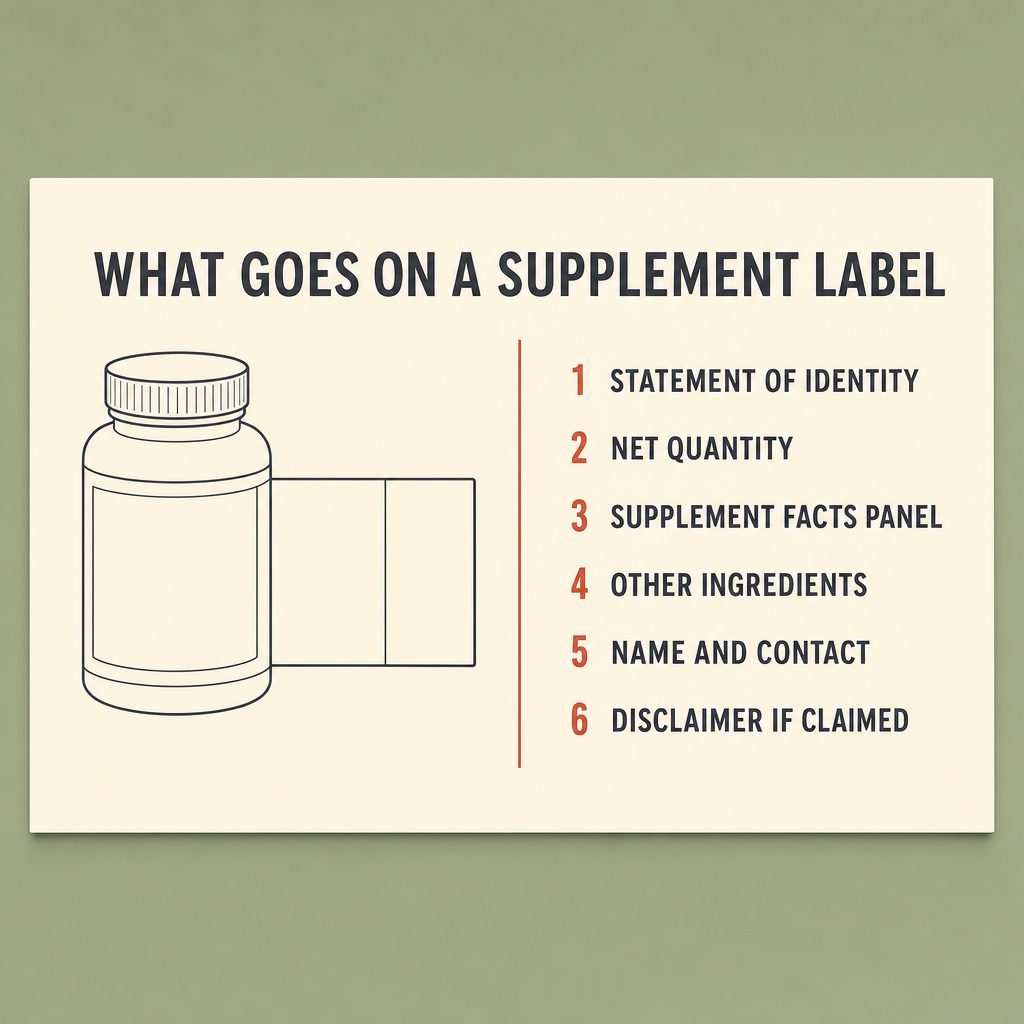
Five elements are required on every dietary supplement label, plus a sixth when the label makes a structure/function claim. The FDA’s Dietary Supplement Labeling Guide is the reference, and it divides the package into two zones: the principal display panel that faces the shopper, and the information panel immediately to its right.
- Statement of identity. The product name together with the words “dietary supplement,” or that term with the word “dietary” replaced by the ingredient type, such as “herbal supplement.” It belongs on the principal display panel.
- Net quantity of contents. The count, weight or volume, in the bottom 30 percent of the principal display panel.
- Supplement Facts panel. Usually on the information panel, built to the format described below.
- Other ingredients. Everything that is not a dietary ingredient, such as capsule gelatin, fillers, binders and flow agents, listed in descending order of predominance, generally just below the panel.
- Name and place of business. The manufacturer, packer or distributor, plus a domestic address or domestic phone number through which serious adverse events can be reported.
- The disclaimer, wherever a structure/function claim appears. More on that below.
Allergen labeling also applies. If the product contains a major food allergen, it has to be declared, either in the ingredient statement or in a “Contains” line. Supplements built on soy lecithin, fish oil or milk-derived proteins trip this more often than founders expect.
How the Supplement Facts panel is built
The panel is a box with a fixed reading order, and reviewers check that order. From the top: the title “Supplement Facts,” then serving size and servings per container, then a heading row for “Amount Per Serving” and “% Daily Value,” then the dietary ingredients that have Daily Values, then the ingredients that do not, then the footnotes.
Several rules shape the layout more than designers expect:
- Type size and leading are regulated. The panel has minimum type sizes, and the title must be larger than everything else in the box. Shrinking the panel to fit a small bottle is the most common way a label becomes non-compliant.
- Hairlines and bars separate sections. The heavy and light rules in the panel are part of the format, not decoration.
- Serving size is the maximum amount the label recommends per occasion, not a prescribed reference amount as on food. It has to match the directions for use printed elsewhere on the label.
- Small packages get alternatives. When the information panel genuinely cannot hold the full panel, the regulation allows tabular and linear formats. They are permitted for a reason, not as a design preference.
Most of these rules are easy to follow when the panel is built first and the artwork is designed around it. They are hard to follow when the artwork is finished and the panel is squeezed into whatever space is left. White Graphics prepress can build the panel from a formulation spreadsheet in the current FDA format, place it on the information panel, and flag anything that looks off before the job goes to press. The label is produced to the spec the brand approves; claims and filings stay with the brand’s regulatory advisor.
Structure/function claims and the disclaimer
A structure/function claim describes how an ingredient affects the normal structure or function of the body: “supports joint comfort,” “helps maintain healthy energy levels.” These claims are allowed on supplements, but every one of them triggers a required disclaimer, set out at 21 CFR 101.93:
“This statement has not been evaluated by the Food and Drug Administration. This product is not intended to diagnose, treat, cure, or prevent any disease.”
The plural form, “These statements,” is used when the label carries more than one claim. The disclaimer has to appear on each panel where a claim appears, either directly next to the claim or linked to it by a symbol such as an asterisk. When it is not directly next to the claim, it has to be set off in a box.
The bigger risk is not the disclaimer but the claim itself. “Supports immune function” is a structure/function claim. “Prevents colds” is a disease claim, and a disease claim can turn a supplement into an unapproved drug in the eyes of the FDA. Marketing copy written for a website tends to drift across that line when it migrates to a label. Flagging that drift is part of a careful prepress review; deciding the wording is the regulatory advisor’s call.
Supplement label design: where space runs out
Good supplement label design is mostly an exercise in allocating space before anyone gets attached to a layout. A 60-count bottle has a few square inches of usable surface, and the required copy does not shrink with the bottle.
Three habits keep a design workable:
- Measure the real container. A die drawn off the actual bottle or jar, not a stock template that almost fits, tells you where the label can live without wrinkling over a shoulder or a taper.
- Reserve the information panel first. Place the Supplement Facts box, other ingredients, the disclaimer, warnings and the contact line at their minimum legal sizes, and design the brand panel into the remaining space.
- Design the family, not the bottle. Supplement lines sell through shelf blocking, a run of SKUs presenting one brand system. Holding the brand color identical across a pre-workout, a creatine and a multivitamin is a press discipline as much as a design one, which is why brand color consistency and G7 Master qualified color management matter to small brands as much as large ones.
When the required copy genuinely will not fit, the answer is usually a larger label wrap, a full wrap instead of front and back panels, or a move to a format with more room, such as a pouch or a carton. A printed prototype on the real container settles the question faster than any number of screen mockups, which is the same argument made for prototype packaging in every other category.
Materials that survive daily handling
A supplement bottle is opened every day, often with damp or oily hands, and it lives in bathrooms, kitchens and gym bags. Uncoated paper scuffs and absorbs whatever it touches, and the first casualty is the smallest type on the label, which is the panel copy both the customer and the FDA need to read.
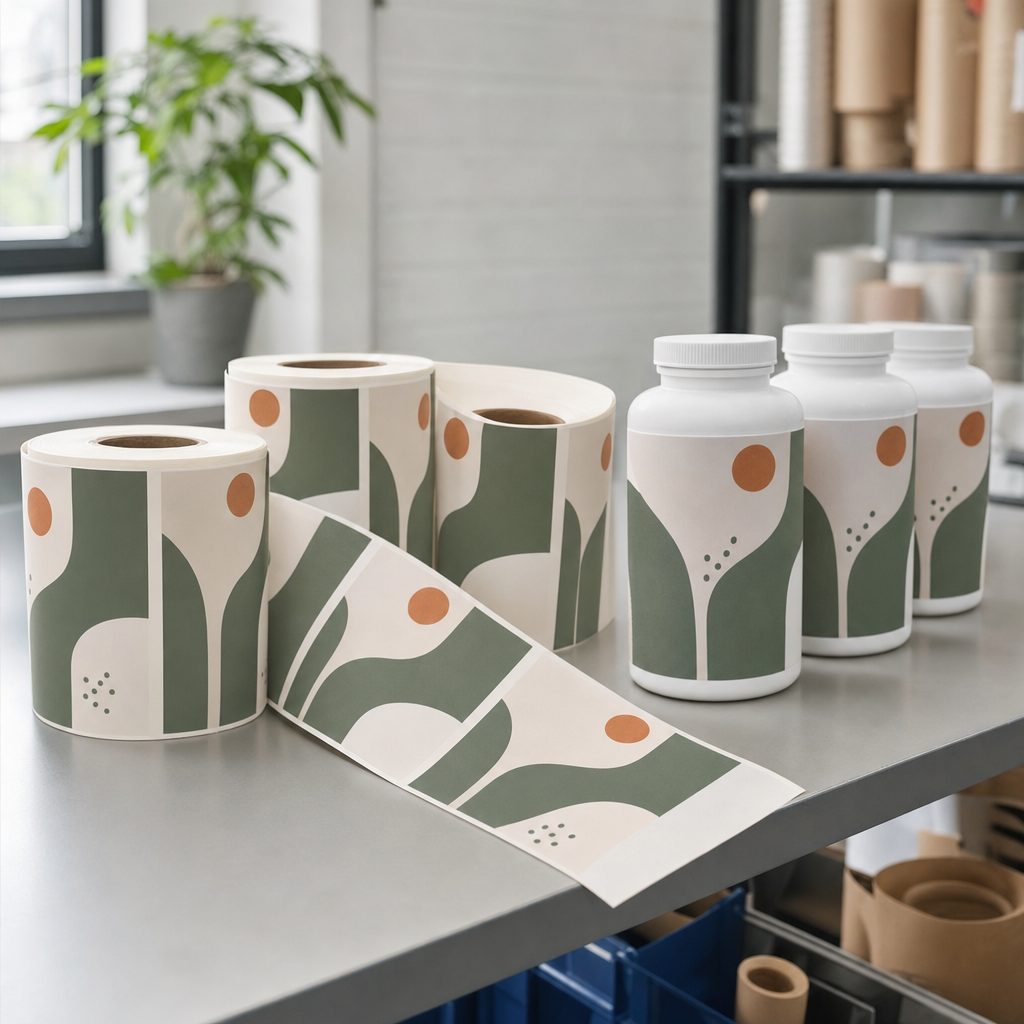
For products handled daily, the usual build is a durable white film with an oil- and moisture-resistant laminate, matched with an adhesive suited to the container: HDPE packer bottles, amber or flint glass, PET jars or squeeze tubes. For dry, shelf-stable products that are not handled often, coated papers keep the cost down without giving up print quality. Finished rolls are wound to the applicator spec of the filling line, so the labels go on straight at production speed. The vitamin label and health and nutrition label lines follow the same logic.
Lot codes, dates and the barcode
Supplement manufacturers have to be able to trace every batch, and the lot number on the label is where that traceability meets the customer. Expiration or best-by dates are common too, although they are not federally required on supplements.
There are two ways to get that information onto a label. One is to print a blank space and add the code later with an inkjet or stamp on the filling line. The other is to print it as part of the label run with variable data printing, where lot numbers, dates and even unique per-unit codes come straight from a data file in a single pass, with no plates and no versioning penalty. The second route removes a step that tends to smear, drift or get skipped.
For retail products, the UPC sits on the label as well. A barcode that is too small, too glossy or printed in a red-family color can fail at the register even though it looks fine on screen. White Graphics builds the symbol from the GTIN the brand provides and scan-checks printed output before it ships. Retail is also beginning a move toward 2D barcodes, covered in our guide to GS1 Sunrise 2027.
What to send with a quote request
A useful quote needs the container (ideally a physical sample or its spec sheet), the rough quantity per SKU, the number of SKUs, and how the labels go on: by hand or on an applicator. If the formulation exists only as a spreadsheet, send it; the panel can be built from it. If finished artwork exists, send it as vector PDF, AI or EPS with the panel and disclaimer as live type.
The same setup carries a line from its first production run to contract-manufacturing volume with consistent color. Short runs also make reformulation less painful: when a serving size or an ingredient changes, the label stock on hand is weeks of supply rather than a year of obsolete rolls.
FAQ
What is the difference between Supplement Facts and Nutrition Facts?
Supplement Facts is the panel for dietary supplements and Nutrition Facts is the panel for conventional foods. Supplement Facts lists dietary ingredients without Daily Values inside the panel, allows source ingredients and proprietary blends, and leaves out nutrients present at zero. The two are built to different FDA rules.
What has to be on a dietary supplement label?
A statement of identity with the words “dietary supplement,” the net quantity of contents, a Supplement Facts panel, an “other ingredients” list, and the name and place of business with a domestic address or phone number for adverse event reports. Labels with structure/function claims also need the FDA disclaimer.
Do supplement labels need the FDA disclaimer?
Only when the label makes a structure/function claim, such as “supports joint comfort.” Each such claim needs the disclaimer stating the claim has not been evaluated by the FDA and the product is not intended to diagnose, treat, cure or prevent any disease, placed on the same panel, next to the claim or linked to it by a symbol.
Can you build the Supplement Facts panel from my formulation?
Yes. Send the formulation spreadsheet and prepress lays out the panel in the current FDA format, positions it on the information panel, and flags anything questionable, such as a missing serving size or disease language in the claims, before printing. Final wording and filings stay with your regulatory advisor.
What material is best for supplement bottle labels?
For bottles handled daily, a durable white film with an oil- and moisture-resistant laminate keeps the panel legible through fingerprints, powder dust and humidity. Coated paper suits dry products that are rarely handled. The adhesive is matched to the container, whether HDPE, glass or PET.
Get a label built for review and the gym bag
Send the container, the formulation or the artwork, and the rough quantity per SKU, and request a quote from White Graphics; the quote comes back with a review of the panel. The full range of formats is on the supplement labels page, and every other category is in the custom label catalog.
About the publisher
White Graphics is a G7 Master qualified custom label and packaging company managed out of Naperville, Illinois, serving food, beverage, supplement, cosmetic, and household-product brands across North America since 1972. Learn more about the company or see the full range of capabilities.