
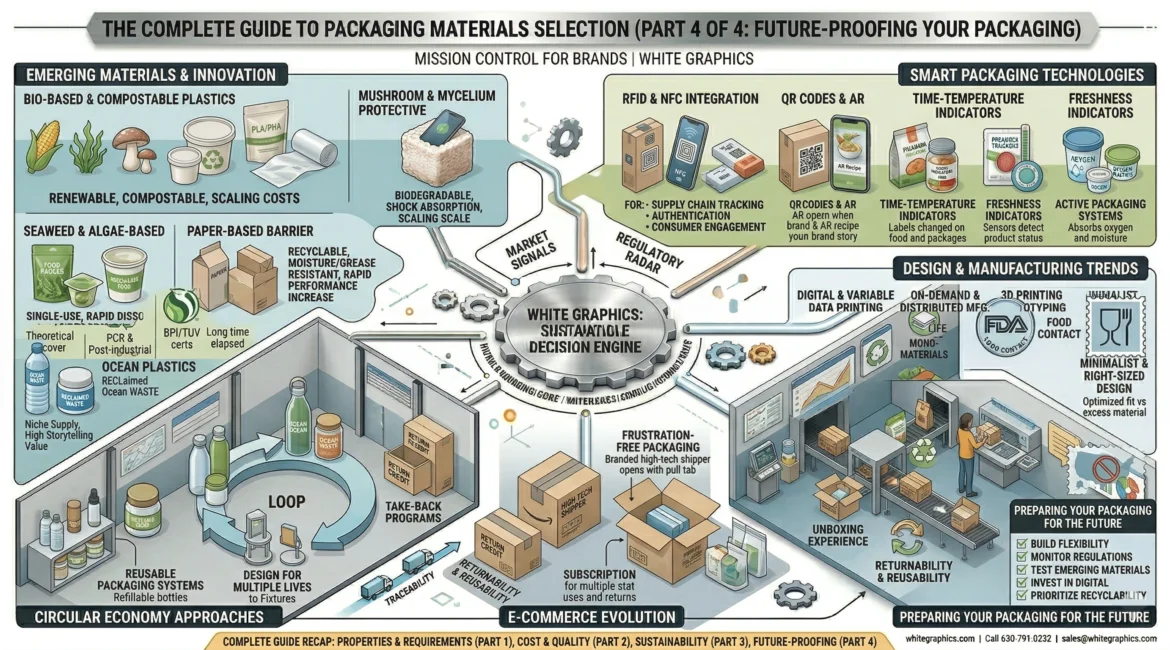
This is Part 4 of our 4-part comprehensive guide to packaging materials selection.
In Part 1, we covered material properties. In Part 2, cost-quality balance. In Part 3, sustainability and compliance. Now we look ahead: what forces are reshaping packaging over the next decade, and how do you position your program to stay ahead of them?
Forces Driving Packaging Innovation
Sustainability Imperatives
Regulatory pressure, retailer requirements, and consumer expectations are accelerating the transition away from non-recyclable materials and toward circular economy models. The innovation response is generating new material categories, new recycling infrastructure investments, and new design standards at a pace unprecedented in the packaging industry.
E-Commerce Growth
Online retail now accounts for a growing percentage of consumer goods sales across nearly every category—and e-commerce packaging requirements are fundamentally different from retail shelf requirements. The growth of direct-to-consumer shipping is driving demand for packaging that performs across the last-mile delivery environment: frustration-free opening, damage resistance through parcel handling systems, and minimal void fill.
Smart Packaging
The integration of digital technology into physical packaging—through QR codes, NFC chips, RFID tags, and sensor-based indicators—is enabling new forms of consumer engagement, supply chain visibility, and product authentication that weren’t possible with passive packaging materials.
Supply Chain Pressures
Global supply chain disruptions have accelerated interest in near-shoring, supplier diversification, and inventory optimization—all of which have packaging implications. Brands are increasingly prioritizing supply chain resilience alongside cost optimization, and packaging suppliers that offer domestic production, flexible run capabilities, and multiple material sourcing options are gaining strategic importance.
Personalization and Customization
Consumer expectations for personalized brand experiences—and retailer expectations for rapid SKU proliferation—are driving demand for packaging solutions that can deliver high customization at short runs without cost penalties. Digital printing is the primary technology enabler of this trend.
Emerging Material Innovations
Bio-Based and Compostable Plastics
PLA (polylactic acid) derived from corn starch, PHA (polyhydroxyalkanoates) produced by microbial fermentation, and TPS (thermoplastic starch) composites represent the leading edge of bio-based plastic alternatives. These materials offer renewable feedstocks and, in certified industrial composting conditions, biodegradation pathways that petroleum-based plastics cannot provide.
The current limitations are significant: cost premiums over conventional plastics, performance gaps in barrier and heat resistance, and composting infrastructure that serves only a fraction of the U.S. consumer market. These limitations are real but improving—cost curves are coming down, formulation performance is improving, and composting infrastructure is expanding with regulatory support.
Mushroom and Mycelium Packaging
Mycelium composites—grown from agricultural waste bound together by fungal root structures—are emerging as a viable alternative to expanded polystyrene (EPS) for protective packaging applications. Companies including Ecovative Design have commercialized mycelium-based packaging for protective end-caps, cushioning, and structural inserts. The material is home-compostable, competitively priced for protective applications, and carries strong sustainability credentials.
Seaweed and Algae Materials
Agar and carrageenan (derived from seaweed) are being developed into films, coatings, and rigid packaging formats. These materials are fully biodegradable in marine environments—an important attribute given the scale of ocean plastic pollution—and can be produced without fresh water or agricultural land. Commercial-scale availability is still limited, but pilot programs with major brands are advancing the commercialization timeline.
Paper-Based Barrier Packaging
One of the most commercially significant material innovations of the past five years is the development of paper-based barrier coatings that can replace PE laminations on food packaging while maintaining recyclability in standard paper streams. Companies including Billerud, Sappi, and Mondi have commercialized paper substrates with aqueous dispersion coatings that deliver moisture and grease barriers equivalent to PE lamination at comparable cost—without compromising recyclability. This innovation is enabling the transition away from PE-laminated paper and board across a wide range of food packaging applications.
Recycled Ocean Plastics
Plastics recovered from ocean and coastal environments are being processed into packaging materials by a growing number of suppliers. While volume limitations make ocean plastic a premium niche rather than a mainstream material, brands in personal care, beverage, and outdoor lifestyle categories have successfully used ocean-recovered plastic content as a powerful sustainability narrative—one that consumers consistently respond to positively in research.
Smart Packaging Technologies
RFID and NFC
Radio frequency identification (RFID) and near-field communication (NFC) tags embedded in or applied to packaging enable item-level tracking through supply chains, anti-counterfeiting authentication, and consumer engagement via smartphone interaction. RFID has been standard in apparel and retail supply chains for years; NFC consumer engagement applications are growing rapidly in premium beverages, personal care, and nutraceuticals.
QR Codes and Augmented Reality
QR code scanning has become mainstream consumer behavior post-pandemic, enabling packaging to serve as a digital touchpoint for product information, usage instructions, brand storytelling, loyalty programs, and sustainability credentials. Augmented reality activations—virtual try-on, 3D product visualization, interactive brand experiences—are extending packaging’s role from static communication to interactive engagement.
Time-Temperature Indicators
Time-temperature indicator (TTI) labels change color to indicate cumulative thermal exposure, providing supply chain managers and consumers with visible evidence of cold-chain integrity. Applications include fresh produce, seafood, pharmaceuticals, and any product where temperature excursions affect safety or quality.
Freshness Indicators
Colorimetric indicators that respond to gases produced by microbial spoilage or oxidation are enabling real-time freshness communication directly on food packaging. These indicators eliminate the need for conservative “best by” dates that result in premature food waste—and provide consumers with more reliable freshness information than fixed date codes.
Active Packaging
Active packaging incorporates functional additives that interact with the product or its environment to extend shelf life or maintain quality: oxygen scavengers, moisture regulators, antimicrobial agents, and ethylene absorbers. These technologies are well-established in specialty food and pharmaceutical applications and are expanding into mainstream consumer goods.
Design and Manufacturing Trends
Digital and Variable Printing
High-speed digital presses are now capable of producing packaging at quality levels approaching conventional offset and gravure, while enabling capabilities that conventional print cannot match: variable data printing, personalization at scale, no-minimum-quantity runs, and rapid artwork iteration. Digital print is enabling business models—regional flavor variants, personalized seasonal packaging, limited-edition programs—that were economically infeasible with plate-based print.
On-Demand Manufacturing
The combination of digital print, rapid structural prototyping, and flexible converting capabilities is enabling genuinely on-demand packaging production—small quantities of finished packaging produced quickly and cost-effectively without the minimum order commitments that conventional packaging supply chains require. This model suits direct-to-consumer brands, test and learn programs, and seasonal SKU strategies.
3D Printing for Structural Prototyping
While 3D printing is not yet competitive with conventional converting for production quantities, its role in structural packaging prototyping has transformed the development process. Physical prototypes that once required weeks and $5,000–$15,000 in tooling can now be produced in hours at minimal cost—compressing development cycles and enabling more iterations before production commitment.
Minimalist Design Trends
Consumer research consistently shows growing preference for clean, honest, minimal packaging aesthetics over maximalist design approaches. This trend is aligned with sustainability objectives—simpler graphics require fewer ink colors and simpler production processes—and is reshaping brand design briefs across categories from food to personal care to household products.
E-Commerce Packaging Evolution
Frustration-Free Packaging
Amazon’s Frustration-Free Packaging program, and the consumer expectation it has generalized, is driving redesign of packaging across categories. Consumer goods that were designed for retail shelf integrity must be redesigned for easy opening, minimal waste, and damage-free transit in parcel delivery systems. The frustration-free design brief is fundamentally different from the retail shelf design brief—and most legacy packaging fails at one or the other.
Unboxing Experience
For premium direct-to-consumer brands, packaging is a brand experience touchpoint equivalent to a retail store. The unboxing sequence—outer shipper, tissue paper, inner packaging, product presentation, inserts—is designed as a choreographed brand narrative. Investment in unboxing experience generates social media sharing, positive brand associations, and repeat purchase in ways that commodity shipping packaging cannot.
Returnability
As e-commerce return rates persist at 15–30% across categories, packaging that enables clean, easy product return is becoming a competitive differentiator. Resealable closures, tear strips that enable controlled opening without destroying reuse utility, and pre-printed return labels integrated into outer packaging are examples of return-optimized packaging features.
Subscription and Refill Models
Subscription commerce and product refill models are generating packaging requirements that differ fundamentally from single-purchase packaging: durability for repeated use, refill-compatible formats, return and reuse logistics. Brands like Grove Collaborative, Loop, and Blueland have pioneered packaging systems designed from the ground up for refill and reuse business models.
Circular Economy Approaches
The circular economy reframes packaging from a linear (make-use-discard) model to a closed-loop (make-use-recover-remake) model. Practical circular economy approaches in packaging include take-back programs, reusable packaging systems, deposit return schemes, and partnerships with material recovery facilities to develop local recycling capacity for materials currently landfilled.
Brands that are building circular packaging systems now—even at pilot scale—are developing the operational expertise and supplier relationships that will become competitive requirements as regulatory and consumer pressure for circular packaging intensifies.
Preparing for the Future
The practical approach to future-proofing your packaging program is not to try to predict which specific materials or technologies will win—the innovation landscape is moving too fast for confident long-range predictions. Instead, build organizational capabilities and supplier relationships that allow you to adapt quickly as the landscape evolves:
The packaging decisions you make today have a long runway—tooling investments, supplier commitments, and structural designs persist for years. Making those decisions with a clear-eyed view of material performance, cost tradeoffs, sustainability requirements, and future trends is how packaging programs serve brands for the long term rather than creating short-cycle replacement costs.
Ready to future-proof your packaging program? Contact White Graphics: Call 630.791.0232 or email sales@whitegraphics.com.
- Part 1: Material Properties and Performance Requirements
- Part 2: Cost vs. Quality: Finding the Right Balance for Your Product
- Part 3: Sustainability and Compliance: Navigating Environmental Responsibility
- Part 4: Future-Proofing Your Packaging: Emerging Materials and Trends (This Article)
Ready to get started? Contact White Graphics to discuss your packaging needs.
