
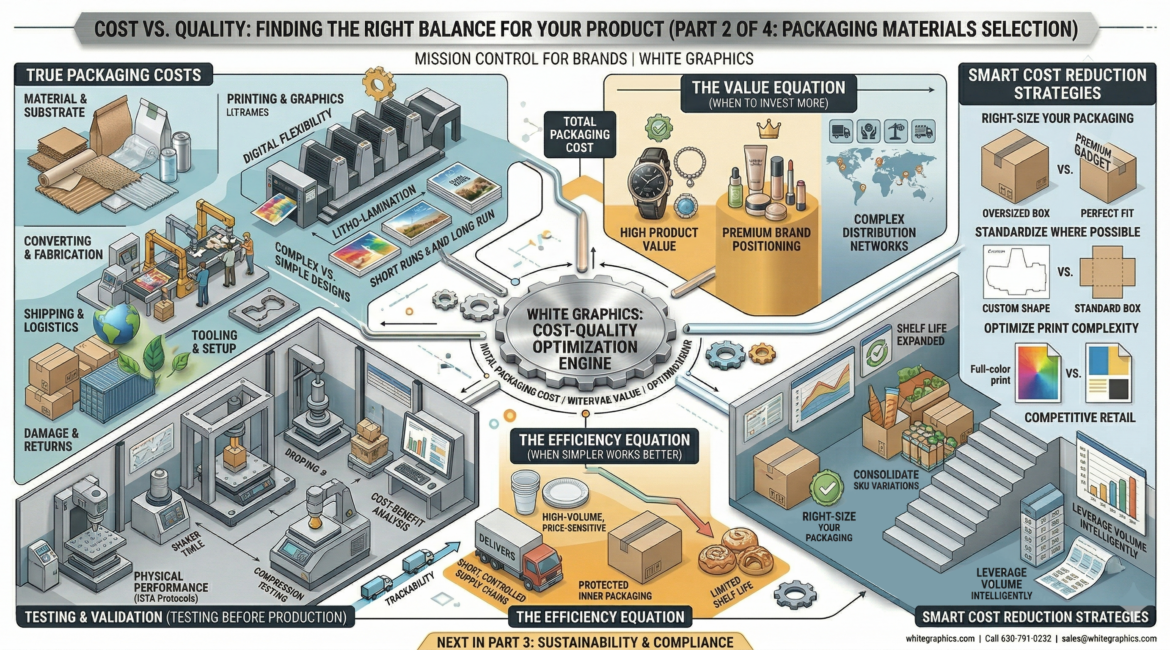
This is Part 2 of our 4-part comprehensive guide to packaging materials selection.
In Part 1, we covered the fundamentals of material properties and performance requirements. Now we tackle one of the most common challenges in packaging decisions: balancing cost against quality when budget constraints are real but so are the consequences of cutting corners.
Understanding True Packaging Costs
The first mistake most brands make is equating packaging cost with material unit price. True packaging cost is a fully-loaded calculation that includes every dollar spent between raw material and delivered product.
Material Cost
The per-unit cost of the substrate, inks, coatings, and closure components. This is typically the number quoted in initial supplier conversations—and the least informative number in the full cost picture.
Printing and Converting
Plate or cylinder costs, setup charges, minimum run quantities, and per-unit print costs vary dramatically across print processes. Digital print has no plate cost but higher per-unit ink cost. Flexo and gravure have significant tooling investment that amortizes efficiently at high volumes. Folding carton converting adds die-cutting, scoring, and gluing costs on top of print.
Tooling and Setup
Dies, plates, cylinders, and molds are capital expenses that must be amortized across production runs. A custom die for a unique folding carton structure can run $2,000–$8,000. At 10,000 units, that’s $0.20–$0.80/unit in tooling alone—a cost that drops to pennies at 500,000 units. Tooling economics strongly favor brands that can commit to higher volumes.
Shipping and Logistics
Packaging weight and cube efficiency directly determine freight cost per unit shipped. A packaging redesign that reduces case weight by 20% or improves pallet stack density by 15% may generate more savings in freight than the material cost difference between options. Always model freight cost when evaluating structural redesigns.
Damage and Returns
Under-engineered packaging that fails in distribution generates chargebacks, returns, replacement product costs, and brand damage. A corrugated case that saves $0.12/unit but generates 2% damage claims in transit is dramatically more expensive than a $0.20/unit case that ships cleanly. Model damage rates from current packaging before accepting a lower-cost alternative.
Shelf Life Impact
Packaging that delivers inadequate barrier performance shortens effective shelf life, increases spoilage and returns, and degrades brand quality perception. For food and supplement products, the cost of premature spoilage frequently exceeds any savings from a lower-barrier, lower-cost substrate.
When to Invest More in Packaging Quality
High Product Value-to-Packaging Cost Ratio
When your product costs $50–$200 per unit, the difference between a $0.80 and a $1.40 packaging solution is immaterial compared to the brand impression delivered and the damage risk reduced. Premium packaging ROI is highest when the product inside commands a premium price.
Premium Brand Positioning
Packaging is the first physical expression of your brand promise. A consumer who pays $35 for a specialty supplement or $22 for an artisan food product has already signaled willingness to pay for quality. Packaging that looks and feels like a commodity undermines that premium positioning regardless of what’s inside. Invest in packaging that delivers the same quality signal as your product.
Complex or Demanding Distribution
E-commerce, international export, club store floor stacks, and refrigerated distribution all impose physical stresses that demand higher structural specifications. Brands that try to run the same packaging across all channels frequently discover that the spec adequate for retail shelving generates 4–8% damage in e-commerce fulfillment. Engineer for your most demanding distribution channel.
Extended Shelf Life Requirements
If your product needs 18–24+ months of shelf stability, barrier performance is not negotiable. The incremental cost of a high-barrier laminate structure over a basic film is typically $0.05–$0.20/unit—trivial compared to the cost of a product recall or category-wide shelf life reduction.
When Simpler Packaging Works
Commodity and Functional Products
Hardware, cleaning supplies, industrial components, and commodity food items where purchase decisions are driven by price and function rather than brand experience can often perform equally well in simpler, lower-cost packaging. When your consumer is buying price per ounce rather than brand story, packaging investment above functional minimums rarely generates returns.
Short or Controlled Supply Chains
Direct-to-consumer brands with short distribution paths—local, regional, or warehouse-to-door fulfillment—can often accept lighter structural specifications than brands shipping through multiple distribution nodes. When you control the handling and eliminate the chaotic retail supply chain, you can design to that controlled environment.
Test and Learn Phases
New product launches and line extensions that haven’t yet proven market traction benefit from lower-cost, shorter-run packaging options that preserve capital while the business case develops. Digital printing enables premium graphics on cost-appropriate substrates with no minimum quantity penalty—ideal for market validation phases.
Smart Cost Reduction Strategies
Standardize Structural Components
Brands with multiple SKUs often carry unnecessary structural diversity—five different box sizes where three would serve the same range. Standardizing to fewer structural forms amortizes tooling costs across higher volumes, simplifies inventory, and enables better procurement leverage with suppliers.
Optimize for Production Efficiency
Small changes in structural dimensions can dramatically improve production yield from a standard press sheet or roll width. A carton that’s 1/8″ narrower might eliminate a full step-and-repeat position from the die layout, improving yield by 15%. Collaborate with your converter on dimension optimization before finalizing structural specs.
Right-Size Your Run Quantities
Over-ordering to achieve lower per-unit pricing makes sense only when inventory carrying costs, obsolescence risk, and working capital impact are included in the analysis. A fresh design iteration or regulatory label update can make an over-stocked inventory worthless. Model the full inventory economics, not just the unit price break.
Evaluate Digital vs. Conventional Print
Digital printing is cost-competitive with conventional flexo/gravure at quantities below 50,000–75,000 units for many label formats. Above those thresholds, conventional print with amortized plates typically wins on per-unit cost. Brands running multiple SKUs or frequent artwork updates often find digital print superior even at moderate volumes when changeover and plate costs are factored in.
Consolidate Your Supplier Base
Working with a full-service packaging partner rather than managing four separate suppliers for labels, cartons, corrugate, and fulfillment generates volume leverage, reduces project management overhead, and eliminates the coordination cost of multi-vendor supply chains. The savings in time and errors frequently exceed any individual material cost savings from specialized sourcing.
Testing and Validation: Don’t Skip This Step
Cost reduction decisions that aren’t validated through proper testing frequently cost more than they save. Our testing capabilities simulate real-world shipping and handling conditions, allowing you to verify that a lower-cost material alternative actually performs to specification before committing to a production run.
Require physical test data—compression, drop, moisture, and seal integrity results—before accepting a supplier’s claim that a lower-cost alternative is “equivalent” to your current spec. Subjective quality claims from a supplier with a financial interest in the decision are not a substitute for objective test results.
Real-World Example: Industrial Component Packaging
A manufacturer of precision industrial components was packaging each unit in a custom injection-molded plastic case at $18/unit in packaging cost. A packaging audit revealed that the plastic case had been specified for a retail environment the product no longer served—the product was now sold exclusively through industrial distributors who unpacked and binned components on arrival.
Redesigning to a custom corrugated insert tray with a plain outer carton—engineered specifically for the actual distribution environment—reduced packaging cost to $4.50/unit. At 45,000 units/year, the saving was over $300,000 annually. The “lower quality” packaging delivered better protection for the actual distribution scenario than the premium retail case it replaced.
Common Cost-Cutting Mistakes
- Reducing gauge on structural materials without validating compression performance under actual stack loads
- Switching barrier films without conducting accelerated shelf-life testing to verify equivalent performance
- Eliminating secondary packaging without modeling the damage rate impact in your specific distribution environment
- Accepting a supplier’s “equivalent” claim without requiring and reviewing actual test data
- Optimizing unit cost without modeling total cost including freight, damage, returns, and inventory carrying costs
Finding Your Optimal Balance
The right cost-quality balance is defined by your product, your brand, your supply chain, and your volume—not by industry averages or competitor benchmarks. The framework for finding it is straightforward: start with hard performance requirements that are non-negotiable, then optimize cost within those constraints using the strategies above.
Packaging is not the place to find the last dollar of savings on a high-value product. Nor is it the place to over-invest in premium structure when functional performance adequately serves your actual distribution and customer expectations. Know your requirements, test your alternatives, and make decisions based on total cost—not unit price.
Ready to find the right cost-quality balance for your packaging? Contact White Graphics: Call 630.791.0232 or email sales@whitegraphics.com.
Next up in Part 3: Sustainability and Compliance—navigating environmental responsibility in packaging material selection.
- Part 1: Material Properties and Performance Requirements
- Part 2: Cost vs. Quality: Finding the Right Balance for Your Product (This Article)
- Part 3: Sustainability and Compliance: Navigating Environmental Responsibility
- Part 4: Future-Proofing Your Packaging: Emerging Materials and Trends
Ready to get started? Contact White Graphics to discuss your packaging needs.
Related reading: what packaging prototypes cost (and what they insure) · short-run packaging economics
