
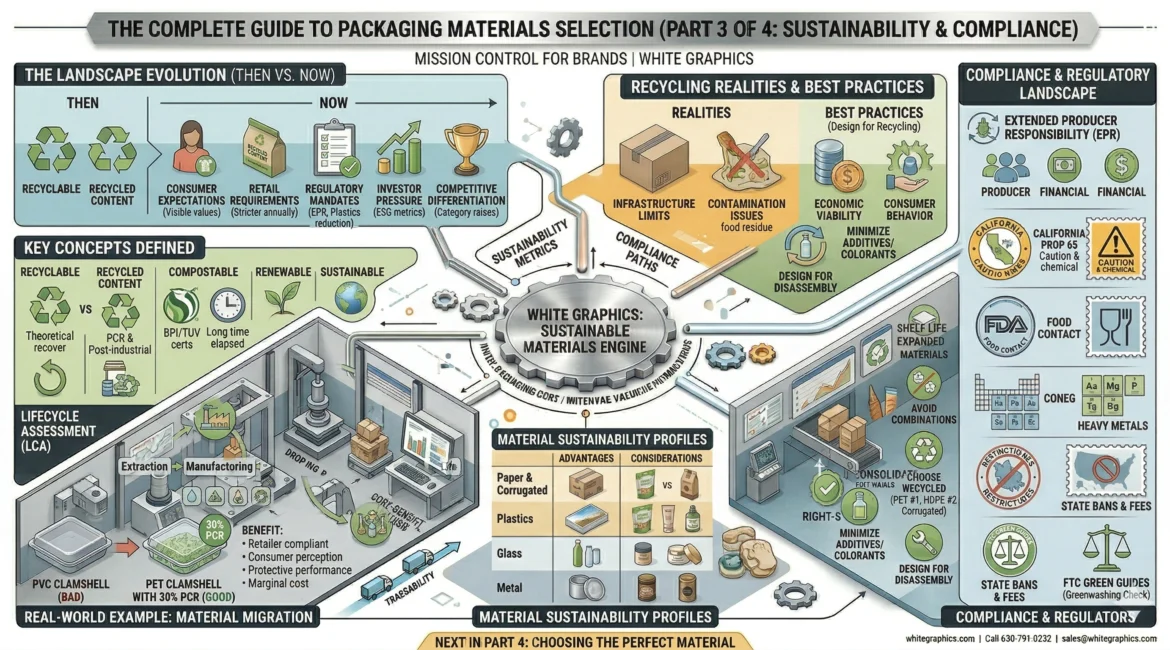
This is Part 3 of our 4-part comprehensive guide to packaging materials selection.
In Part 1, we covered material properties and performance requirements. In Part 2, we addressed cost-quality tradeoffs. Now we turn to one of the most complex and rapidly evolving dimensions of packaging decisions: sustainability and regulatory compliance.
The Sustainability Landscape Has Changed
Five years ago, sustainability in packaging was largely a voluntary differentiator—a brand story element that appealed to eco-conscious consumers and generated favorable press. Today, it’s a multi-layered requirement driven by forces that don’t respond to marketing budgets:
Consumer Expectations
Consumer research consistently shows that sustainable packaging influences purchase decisions across categories, with particularly strong effects in natural and specialty retail. The consumer who reads ingredient labels also reads packaging recycling claims—and increasingly knows the difference between meaningful sustainability credentials and greenwashing.
Retail Requirements
Major retail chains have published formal packaging sustainability requirements that suppliers must meet to maintain shelf placement. Walmart’s Project Gigaton, Target’s sustainability standards, and Whole Foods’ packaging guidelines are not aspirational—they’re supplier requirements with compliance deadlines.
Regulatory Mandates
Extended Producer Responsibility (EPR) laws in California, Colorado, Oregon, Maine, and Minnesota are creating mandatory packaging sustainability requirements with financial consequences for non-compliance. The European Union’s Packaging and Packaging Waste Regulation is reshaping global supply chains. This regulatory wave is accelerating, not retreating.
Investor and ESG Pressure
Public companies and PE-backed brands face investor scrutiny on Environmental, Social, and Governance metrics that increasingly include packaging sustainability. Packaging sustainability is no longer just a consumer-facing story—it’s a financial reporting dimension.
Competitive Differentiation
As sustainability requirements become the floor rather than the ceiling, brands that move early capture the credibility advantage of authentic sustainability leadership rather than scrambling to meet compliance minimums.
Key Sustainability Concepts
Sustainable packaging vocabulary is precise, and the distinctions matter both for accurate consumer communication and for regulatory compliance.
Recyclable vs. Recycled Content
Recyclable means a material can theoretically be processed through recycling infrastructure—but this is only meaningful if that infrastructure actually exists and accepts the material in the communities where your product is sold. A material technically designated as recyclable but not accepted in most curbside programs is not functionally recyclable for most consumers.
Recycled content refers to the percentage of the material that comes from post-consumer or post-industrial recycled feedstock. These are separate claims with separate evidence requirements. The FTC Green Guides require that recyclability and recycled content claims be substantiated and qualified when collection infrastructure is limited.
Compostable vs. Biodegradable
Compostable packaging meets specific ASTM D6400 or EN 13432 standards for breakdown under defined composting conditions within a defined timeframe. Certified compostable packaging is meaningful only when industrial composting infrastructure exists to process it—home compostability has different and more limited certification criteria.
Biodegradable has no standardized legal definition in the U.S. and is considered a problematic claim by the FTC without specific timeframe and condition qualifications. Biodegradable claims without substantiation are a greenwashing liability.
Renewable vs. Sustainable
Renewable feedstocks (sugarcane, corn starch, agricultural waste) are replenished on human timescales, unlike petroleum-based feedstocks. But renewable origin does not automatically mean sustainable production—land use, water consumption, and agricultural inputs matter.
Sustainable sourcing typically requires third-party certification: FSC for forest products, Rainforest Alliance for agricultural inputs, or similar recognized standards.
Lifecycle Assessment (LCA)
LCA evaluates the total environmental impact of a packaging system across its entire life: raw material extraction, manufacturing, transportation, use phase, and end-of-life processing. LCA results often challenge intuitive assumptions—glass has a heavy carbon footprint despite being infinitely recyclable; aluminum has high production energy but exceptional recycling economics.
Material-Specific Sustainability Profiles
Paper and Corrugated
The most broadly recyclable packaging category in North America, with strong domestic collection and processing infrastructure. FSC-certified paper verifies responsible forest management. Recycled content is widely available and frequently cost-neutral versus virgin fiber. Coatings and laminates can complicate recyclability—clay-coated SBS recycles well; PE-coated papers do not in most curbside programs.
Plastics
Recyclability varies dramatically by resin type and form. PET (#1) and HDPE (#2) have robust recycling infrastructure in most North American markets. Polypropylene (#5) recycling is growing. Multilayer flexible laminates remain largely unrecyclable through curbside programs, though emerging take-back and chemical recycling programs are beginning to address this gap. Post-consumer recycled (PCR) content is available for PET and HDPE at meaningful percentages.
Glass
Infinitely recyclable in theory; recycling rates vary by region and collection program. Heavy weight creates a carbon disadvantage in transportation that can offset recycling benefits for products with long or complex supply chains. Strong premium sustainability perception among consumers despite mixed lifecycle results.
Metal
Aluminum has the highest recycling rate of any packaging material in North America and the best energy economics in recycling (75% energy savings versus virgin production). Steel cans are similarly well-recycled. Both materials carry a high embodied energy burden in virgin production—the sustainability case for metal packaging depends heavily on achieving high end-of-life recycling rates.
Navigating Recycling Realities
The most important principle in sustainability packaging claims is that what matters is not theoretical recyclability but actual end-of-life outcomes in the communities where your product is sold. The How2Recycle label program (developed by the Sustainable Packaging Coalition) provides a standardized, consumer-tested labeling system that communicates accurate recyclability instructions based on actual program availability—and is increasingly required by retail partners as the standard for recyclability claims.
Design for Recycling Best Practices
- Minimize material types — packaging made from a single material type recycles more cleanly than multi-material combinations
- Use pressure-sensitive labels that separate cleanly from containers during recycling float/sink processes
- Avoid black carbon pigments — black plastics cannot be detected by NIR optical sorters at recycling facilities and are sorted out as contamination
- Minimize adhesive coverage — heavy adhesive application on paper packaging can reduce pulp quality in recycling
- Design closures and labels as recyclable components or as easily separable elements that consumers can remove before recycling
Compliance and Regulatory Landscape
For Brand Compliance Teams
Coordinating label artwork against shifting regulatory requirements? Our custom label printing guide for brand compliance teams walks through version control, FDA disclosures, and the regulatory artwork checks White Graphics applies on every job.
Extended Producer Responsibility (EPR)
EPR laws require brand owners and importers who sell packaged goods to fund the end-of-life collection and processing of that packaging. California (SB 54), Colorado, Oregon, Maine, and Minnesota have enacted EPR laws with varying implementation timelines and requirements. EPR fees are typically calculated based on packaging material type, weight, and recyclability—creating direct financial incentives for sustainable material choices.
California Proposition 65
Requires warning labels on products that expose Californians to listed chemicals above safe harbor thresholds. Relevant to packaging materials that may transfer chemical substances to food or consumer-contact products. FDA food-contact compliance does not automatically satisfy Prop 65 requirements.
FDA Food Contact Materials
Packaging that contacts food must comply with FDA regulations under 21 CFR, which specify permitted substances, use conditions, and extraction limits for food-contact materials. PCR content in food-contact packaging requires specific FDA authorization beyond standard virgin material compliance.
CONEG Heavy Metals
The Coalition of Northeastern Governors model legislation (adopted by most U.S. states) limits total concentration of lead, cadmium, mercury, and hexavalent chromium in packaging and packaging inks to 100 ppm. Most major ink and coating suppliers comply, but documentation should be requested and maintained.
Plastic Bag and Single-Use Plastic Bans
Over 350 U.S. jurisdictions have enacted restrictions on specific single-use plastic forms. If your packaging includes carry-out bags, polystyrene foam, or certain film formats, verify compliance with the laws applicable in your distribution markets.
FTC Green Guides
The Federal Trade Commission’s Green Guides establish standards for environmental marketing claims. Recyclable, recycled content, compostable, biodegradable, and “eco-friendly” claims all carry specific substantiation requirements. The FTC is currently updating the Green Guides (last revised in 2012), with new guidance expected to tighten standards for recyclability claims in particular.
Real-World Example: Flexible Packaging Sustainability Upgrade
A personal care brand was running a line of bath products in PVC shrink sleeves over HDPE bottles. PVC is incompatible with HDPE recycling streams and was contaminating the recycling value of the bottle itself. A retail sustainability audit flagged the combination as non-compliant with the retailer’s 2026 packaging requirements.
The redesign replaced PVC sleeves with PET shrink sleeves (compatible with PET recycling infrastructure) and increased the bottle’s PCR content from 0% to 30% using FDA-authorized recycled HDPE. The change was cost-neutral on a per-unit basis, eliminated the retail compliance issue, and enabled a legitimate How2Recycle label designation—delivering a consumer-facing sustainability story that the previous packaging couldn’t support.
Balancing Sustainability with Performance
The most common tension in sustainable packaging decisions is the performance-sustainability tradeoff: the most sustainable packaging option sometimes offers lower barrier performance, higher cost, or greater supply chain complexity than a conventional alternative. Resolving this tension requires honest prioritization.
Not every product category demands the highest available barrier performance. Many brands are over-specified on barrier relative to actual shelf-life requirements. A barrier performance audit—comparing actual product shelf-life data against the barrier specification in use—frequently reveals margin for sustainable material substitution that doesn’t compromise product quality.
Practical Steps for Sustainable Packaging Development
- Audit your current packaging portfolio for recyclability, recycled content, and regulatory compliance gaps
- Map your retail partners’ sustainability requirements and identify compliance deadlines
- Assess EPR exposure in states where your product is sold and model the financial impact of different material choices on EPR fees
- Identify highest-impact substitution opportunities — where can you replace non-recyclable materials with recyclable alternatives at acceptable cost and performance?
- Engage your packaging supplier in sustainability material alternatives — a supplier with deep material expertise will have access to sustainable options and emerging material innovations that aren’t on your radar
- Build a sustainability claims documentation file — substantiation records for every environmental claim on your packaging, maintained and updated as materials change
Ready to navigate sustainability and compliance in your packaging decisions? Contact White Graphics: Call 630.791.0232 or email sales@whitegraphics.com.
Next up in Part 4: Future-Proofing Your Packaging—emerging materials, smart packaging technologies, and trends shaping the next decade.
- Part 1: Material Properties and Performance Requirements
- Part 2: Cost vs. Quality: Finding the Right Balance for Your Product
- Part 3: Sustainability and Compliance: Navigating Environmental Responsibility (This Article)
- Part 4: Future-Proofing Your Packaging: Emerging Materials and Trends
Ready to get started? Contact White Graphics to discuss your packaging needs.
