
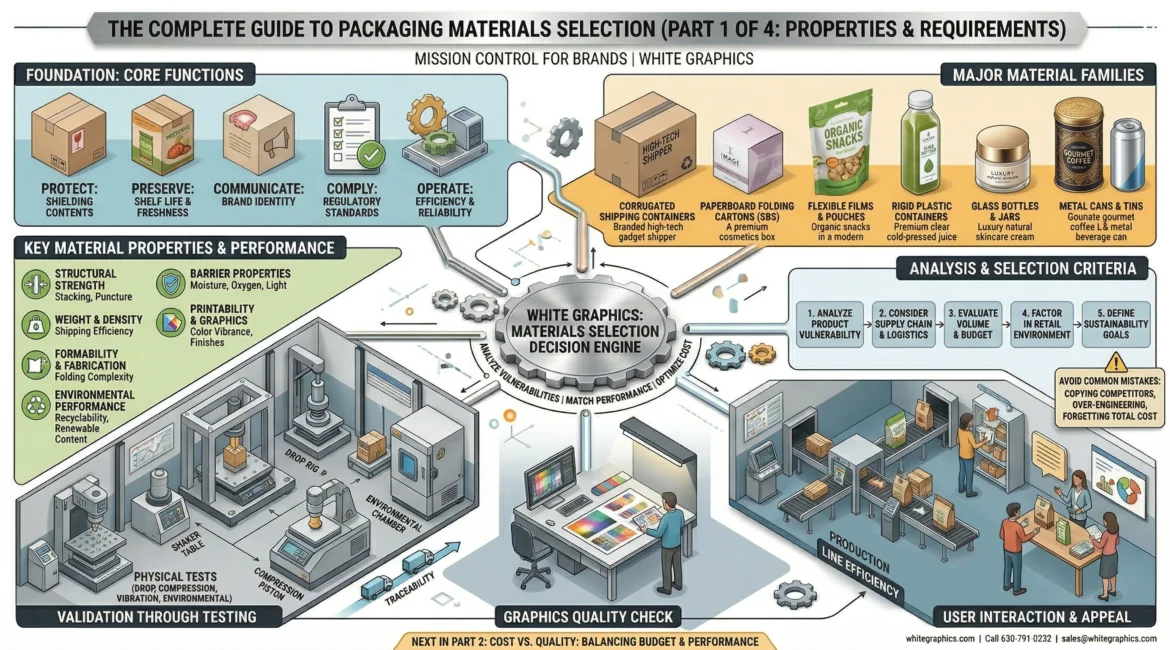
This is Part 1 of our 4-part comprehensive guide to packaging materials selection.
Your product deserves packaging that performs. But with dozens of material options—each with different properties, costs, and applications—how do you choose the right one?
In this first installment, we’ll start with the fundamentals: understanding material properties and matching them to your specific performance requirements.
The Foundation: What Materials Actually Do
Before diving into specific materials, it’s essential to understand the core jobs that packaging must accomplish:
- Protect Your Product — from physical damage, moisture, contamination, and environmental exposure
- Preserve Product Integrity — maintaining freshness, potency, or structural form throughout the supply chain
- Communicate Your Brand — delivering the visual and tactile language of your identity at the point of decision
- Meet Regulatory Requirements — complying with FDA, USDA, and industry-specific compliance mandates
- Operate Efficiently — enabling fast, consistent production on your fill line and in your distribution network
Every material decision is a tradeoff across these five imperatives. The right material maximizes what your product needs most without over-investing in properties that don’t move the needle for your specific application.
Key Material Properties That Matter
Structural Strength
Compression resistance, puncture resistance, and burst strength determine whether your packaging survives the journey from your facility to the consumer’s hands. High-compression environments (club stores, floor stacks) demand corrugated or rigid structures with defined ECT (Edge Crush Test) ratings. E-commerce fulfillment adds drop and vibration stresses that retail-only packaging may not be engineered to handle.
Barrier Properties
Moisture vapor transmission rate (MVTR), oxygen transmission rate (OTR), light barrier, and grease resistance define how well a material shields your product from its environment. Food products with high fat content need grease barriers; oxygen-sensitive supplements need low OTR films; UV-sensitive products need opaque or UV-blocking substrates. Choosing the wrong barrier spec means spoilage, potency loss, or shortened shelf life.
Weight and Density
Every gram of packaging material translates directly to shipping cost. In high-volume, high-frequency supply chains, a 10% reduction in packaging weight can generate significant freight savings over a year. Flexible films win decisively over rigid containers on a weight-per-unit basis; corrugated beats plastic clamshells for most large-format retail applications.
Printability and Graphics Quality
Not all substrates print equally. SBS (Solid Bleached Sulfate) board delivers photo-quality graphics with sharp dot gain control. Kraft papers and natural board stocks provide an organic aesthetic but limit color gamut. Flexible films printed via rotogravure or flexo achieve brilliant color saturation, but require minimum run quantities to amortize cylinder or plate costs. Understanding the print process available for each substrate is essential before committing to a material spec.
Formability and Fabrication
How a material converts—whether it can be die-cut, scored, folded, heat-sealed, or thermoformed—determines what structural forms are achievable and at what cost. SBS converts cleanly into folding cartons. BOPP films laminate and seal for pouches. Corrugated scores and slots into a wide range of box styles. Rigid plastics thermoform into clamshells, trays, and cups. The material you choose must be compatible with your converter’s equipment and tooling.
Environmental Performance
Recyclability, compostability, recycled content percentage, and carbon footprint are now selection criteria alongside functional performance. Retailer sustainability requirements, consumer expectations, and emerging Extended Producer Responsibility (EPR) regulations are making environmental performance a hard requirement in many categories, not a “nice to have.”
The Major Material Categories
Corrugated Cardboard
The workhorse of retail and e-commerce packaging. Available in single-face, single-wall (B-flute, C-flute, E-flute), double-wall, and triple-wall configurations. E-flute offers a smooth surface for high-quality graphics combined with structural integrity—ideal for premium gift boxes and shelf-ready packaging. C-flute is the standard for shipping cases. Corrugated is widely recyclable and can incorporate significant recycled content.
Solid Bleached Sulfate (SBS)
The premium choice for folding cartons: cosmetics, pharmaceuticals, food, and consumer goods that demand pristine white surfaces and superior print quality. SBS is coated on one or both sides for maximum printability. It’s FDA-compliant for food contact and available in FSC-certified grades. Primary limitation is cost versus recycled board alternatives.
Flexible Films and Plastics
Oriented polypropylene (OPP), polyethylene (PE), polyester (PET), nylon (PA), and multilayer laminated structures dominate food, supplement, pet food, and household chemical packaging. Flexible pouches offer exceptional barrier properties at low weight. Shrink sleeves provide 360-degree graphics coverage on any container shape. Selection depends heavily on barrier requirements, seal method, and end-of-life recyclability targets.
Rigid Plastics
PET, HDPE, PP, and PVC serve containers, clamshells, trays, and closures. PET is the most widely recycled rigid plastic and offers excellent clarity for product visibility. HDPE is opaque, durable, and widely accepted in recycling streams. PP is microwave-safe and used extensively for food trays. PVC is being phased out in many applications due to recycling incompatibility and regulatory pressure.
Glass
Premium positioning, barrier performance, and inert product contact make glass the preferred choice for high-value food, beverage, and pharmaceutical applications. Heavy weight and fragility are primary drawbacks. Glass is infinitely recyclable and delivers strong sustainability credentials when end-of-life infrastructure exists.
Metal (Aluminum and Steel)
Aluminum foil laminates and steel cans deliver the highest barrier performance of any packaging format—essential for products with demanding shelf-life requirements. Both materials are highly recyclable. Aluminum pouches and lidding films are increasingly used in premium food and pharmaceutical packaging as alternatives to glass.
Matching Materials to Your Requirements
Start With Product Vulnerability
Map your product’s specific vulnerabilities: Is it moisture-sensitive? Oxygen-reactive? UV-degradable? Fragile under compression? Each vulnerability narrows the material field to substrates that deliver the required protection level.
Consider Your Supply Chain
How your product moves from production to consumer determines the physical stresses your packaging must survive. E-commerce fulfillment is more demanding than retail-to-shelf; international shipping adds humidity, temperature variation, and customs inspection stresses. Map your distribution path and design to the most demanding link in the chain.
Evaluate Volume and Budget
Minimum order quantities, tooling costs, and per-unit material costs vary significantly across material categories. Short-run digital print on SBS folding cartons may cost 3–5× more per unit than long-run flexo on flexible film—but requires no cylinder investment and allows artwork changes between runs. Match material selection to your volume reality.
Account for Retail Environment
Club stores, mass market, specialty retail, and direct-to-consumer each impose different structural, graphics, and sustainability requirements. Club retail demands floor-display-ready packaging with high structural integrity. Natural and specialty channels increasingly mandate recycled content and sustainability certifications. Know where your product sells before finalizing material specs.
Factor In Sustainability Goals
If your brand has published sustainability commitments or your retail partners have packaging requirements, these become hard constraints on material selection. Define your targets (% recycled content, recyclability rate, carbon reduction) early and include them in your material brief.
Testing Before Committing
Physical Testing
Our testing capabilities simulate real-world shipping and handling conditions. Before full production commitment, prototypes should be evaluated for compression performance, drop resistance, seal integrity, and moisture resistance under conditions matching your actual supply chain.
Graphics Testing
Print proofs on the actual substrate, not a digital simulation, to verify color accuracy, dot gain, and surface finish before cylinder or plate investment. Metamerism (color shift under different light sources) is especially important for premium consumer goods displayed under retail lighting.
Line Testing
Validate that your chosen material runs efficiently on your fill and seal equipment. Material gauge, coefficient of friction, and heat-seal temperature windows must be compatible with your production line specifications. A material that’s perfect on paper can add significant downtime if it doesn’t run consistently on your equipment.
User Testing
For consumer-facing primary packaging, test open-ability, reclosability, and overall user experience with target consumers before production launch. Packaging that frustrates consumers at the point of use creates negative brand experiences regardless of how well it performed in transit.
Real-World Example: Food Product Material Selection
A premium organic snack brand was sourcing a new primary package for a line of trail mixes. Initial brief called for a stand-up pouch with strong shelf presence, a resealable closure, and sustainability credentials compatible with their natural grocery retail channel.
Material evaluation narrowed the field to three candidates: a standard BOPP/PE laminate (lowest cost, good barrier, not recyclable), a kraft paper/PE laminate (natural aesthetic, partial recyclability, moderate barrier), and a multilayer flexible pouch combining a metallized barrier film interior with a kraft paper exterior (superior barrier, strong shelf presence, with recyclability claims under emerging flexible film programs).
After testing all three for moisture barrier, print quality, and seal integrity, the brand selected the multilayer kraft-exterior option. The result: superior shelf life protection, a differentiated sustainable story for retail buyers, lightweight shipping economics, and the bold graphic print quality their brand demanded.
Common Material Selection Mistakes
- Choosing based on what competitors use — their supply chain, volume, and product profile may be entirely different from yours
- Over-engineering barrier properties — paying for OTR performance you don’t need adds cost without adding value
- Under-engineering structural performance — the cheapest material that fails in distribution costs far more than a robust material that ships cleanly
- Ignoring production realities — specifying a material your converter can’t efficiently run creates schedule risk and cost overruns
- Forgetting total cost — low unit material cost can be overwhelmed by high tooling, minimum quantity, or waste costs that disappear with a different material choice
Ready to select the perfect material for your packaging needs? Contact White Graphics: Call 630.791.0232 or email sales@whitegraphics.com.
Next up in Part 2: Cost vs. Quality—finding the right balance between budget constraints and performance requirements.
- Part 1: Material Properties and Performance Requirements (This Article)
- Part 2: Cost vs. Quality: Finding the Right Balance
- Part 3: Sustainability and Compliance
- Part 4: Future-Proofing: Emerging Materials and Trends
