
Shrink sleeve labels that stay straight on the curve.
One partner from measured bottle to production rewind: White Graphics, a Naperville, Illinois printer, templates, pre-distorts, prints, and finishes shrink sleeves, and proofs every design before the full run.
What a shrink sleeve label is, and when it beats a pressure-sensitive label.
Stand at the cooler door and look at a bottle from the side. Nearly everything you see is curve: the taper under the cap, the swell of the shoulder, the waist where a hand grips. A pressure-sensitive label claims one flattish panel of that surface. A shrink sleeve label claims all of it. It starts as a printed film tube, slides over the container, and runs through a heat tunnel until it conforms 360 degrees, base to neck.
A shrink sleeve grips by tension, printed on the inside of the film so the ink rides protected between plastic and container. Some containers give the film nothing to grab, a tapered yogurt cup is the classic case, and those take a heat-activated adhesive as well. You will hear the format called shrink wrap labels; the trade name is shrink sleeve. For a straight-sided container decorated on one panel, a label from our pressure-sensitive label library applies faster and asks less of the artwork. Sleeves earn their keep where flat labels fail.
Shrink sleeve labeling makes sense when the container curves in more than one direction, when the design wants all of the surface, when the package lives in ice chests and refrigerated cases, or when tamper evidence should be part of the label itself. To see the format working on a real form, open our retail packaging solutions page and spin the interactive 3D sleeved bottle; watch the art hold together as the shape turns.
Watch a shrink sleeve come together.
Read the video transcript
On a curved bottle, the artwork does all the selling. White Graphics templates, pre-distorts, prints, and finishes shrink sleeve labels: film that shrinks tight to every contour, with color that stays straight on the curve. And every design is proofed before the run. White Graphics, Naperville. Since nineteen seventy-two.
Shrink sleeve printing: why a straight logo needs a curved file.
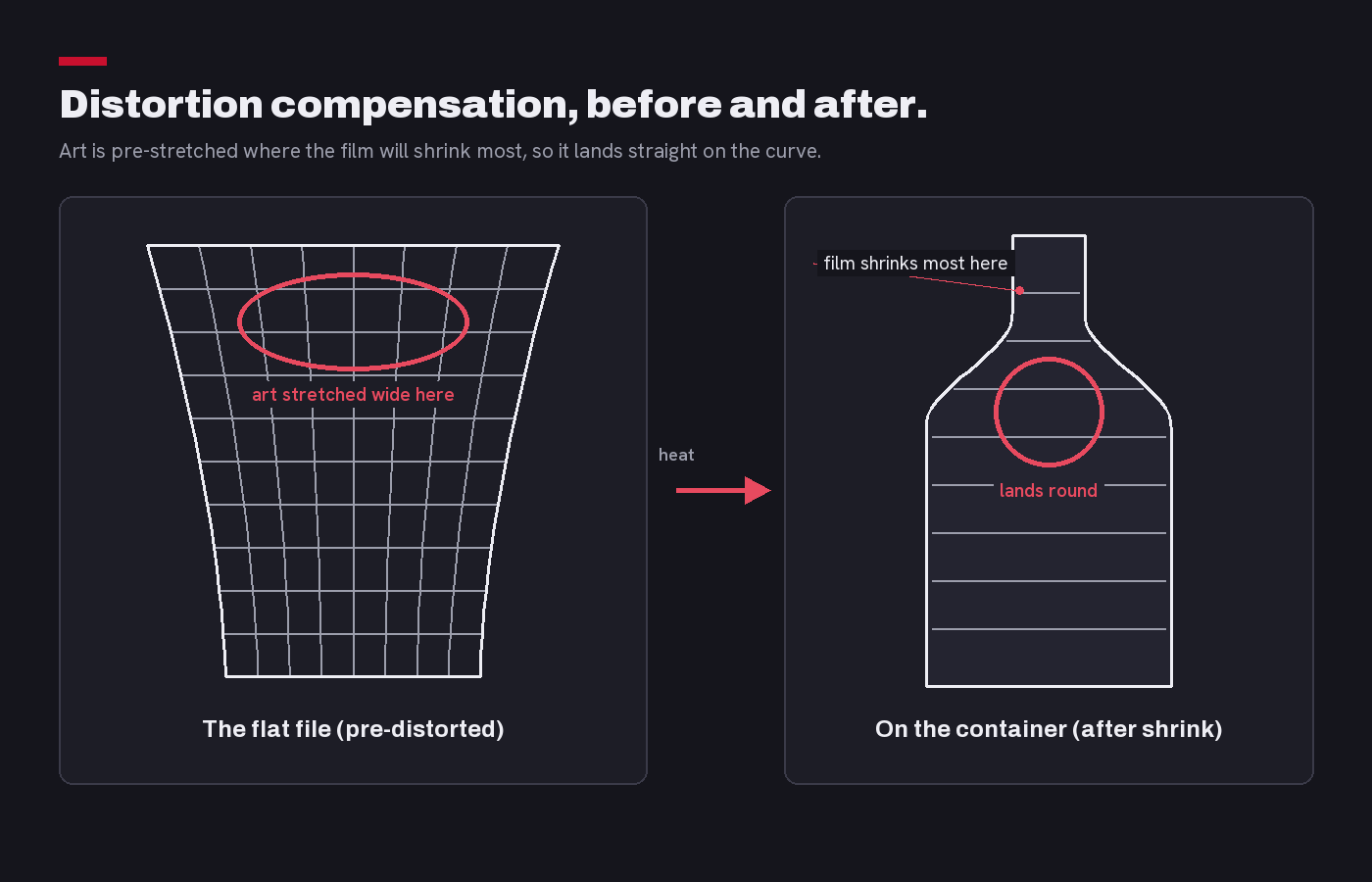
Shrink sleeve printing succeeds or fails in prepress. Film does not shrink evenly; it shrinks in proportion to how far it must travel to reach the container wall. Around a straight waist it barely moves. At the shoulder and neck it can close down dramatically. Print a true circle at the shoulder and the heat tunnel returns an egg. So the art is pre-distorted: stretched where the film will shrink most, so that after the tunnel, curves land round and logos land straight.
The same shrink map decides where copy may live. Barcodes, legal text, and nutrition panels belong in the calmest band of the container, usually the straight section of the body. In curved zones, rotate the barcode so its bars run around the container instead of up it: circumferential shrink then changes the code's overall height, which scanners forgive, and leaves the bar widths they measure untouched. Small type gets the same protection, held out of the zones that compress hardest.
Seam placement gets planned at the same stage. A sleeve is a welded tube, and the vertical weld needs a quiet strip of the layout: solvent seaming bonds film to film, so the overlap must stay free of ink. Our prepress team positions that strip where the design can afford it, in a solid field or along a back-panel edge, never through a face, a logo, or the barcode. The diagram below pairs the flat, pre-distorted file with the same art shrunk on the bottle.
Sleeve films and shrink percentages: how far the artwork can conform.
PETG is the workhorse film: high shrink capability, crisp print, good clarity. PVC still runs for cost-sensitive work, with less conforming range. In practice PETG will follow a contour needing shrink into the seventies, percentage-wise, and PVC into the fifties or low sixties. Those numbers describe typical film behavior. The honest number for your project comes from your container: compare the sleeve's printed layflat width against the smallest diameter it must finish tight on, and that ratio is the shrink you are asking for.
Coverage is a second decision. A full-body sleeve runs base to shoulder, or up over the closure when tamper evidence rides along. A partial sleeve bands one section, a waist wrap on a jar or a mid-panel on a jug, using less film and a simpler application. Both print the same way, and both scale from sampling to production without changing the file, which is what lets a brand test a flavor in the low hundreds and reorder in the tens of thousands.
Gloss is the film's own gift. Sleeves print in reverse, ink laid on the inside surface, so the outside face of the film becomes the finish: smooth, deep, and scuff-protected without a coating. Because sleeve film starts transparent, our presses lay a white underlay behind the color, full color plus white in one pass, so the palette stays opaque and true against amber glass or colored plastic. Every job is proofed and pressed to G7 targets, so the red you approved in the office is the red standing in the cooler.
Shrink bands: tamper evidence at the neck, the cap, or the whole bottle.
A shrink band is the simplest version of the format: a short sleeve over the cap and neck that must tear before the package opens. Perforations do the work. A horizontal perf lets the skirt separate cleanly from the cap; a vertical perf gives a starting point to strip the band away. Food, beverage, and supplement brands lean on them because an intact band reads as a sealed product from across the aisle, and White Graphics prints them in an FDA-registered facility.
Tamper evidence can also ride on the main label. A full-body sleeve extended over the closure, with a perforated break line at the cap, decorates and seals in one application: the shopper tears the perf, the band falls away, and the body art stays put. What counts as adequate evidence differs by category and retailer, and your regulatory advisor owns that final call. Bring us the requirement and the cap dimensions, and the structural team builds the band to meet it.
Artwork setup: design on the container's template, not a flat rectangle.
Every sleeve project starts with the physical container, in hand and measured. Our structural team takes diameters at the base, waist, shoulder, and neck, plus overall height and cap geometry, and builds a layflat template from those numbers with the seam strip, overlap, and shrink zones marked. Designing on a plain rectangle sized to the circumference is how straight logos end up bent. Designing on the template means every element already knows which zone it lives in.
Distortion compensation starts with a physical test. A printed grid sleeve goes onto the physical container and through the tunnel; where each cell lands tells us precisely how the film behaves on that shape, and that measurement drives the compensation applied to your file. Type has floors on shrinking film: hold body copy near six point or larger in calm zones, bigger and bolder where the film works hardest, and give reversed-out type extra weight so the stroke survives the compression.
Approval belongs on the bottle. A flat proof can confirm color and copy; it cannot tell you whether the shoulder pinches your wordmark or the seam grazes the barcode. Before a production run, order a prototype run on your actual container: a finished, shrunk sample you can stand on a shelf, turn in your hand, and judge exactly the way a shopper will, from the side, at arm's length, in a two-second glance.
The Shrink Sleeve Art & Distortion Setup Guide
Container measurements, distortion zones, seam placement, tamper band specs and the prepress checklist, on two printable pages.
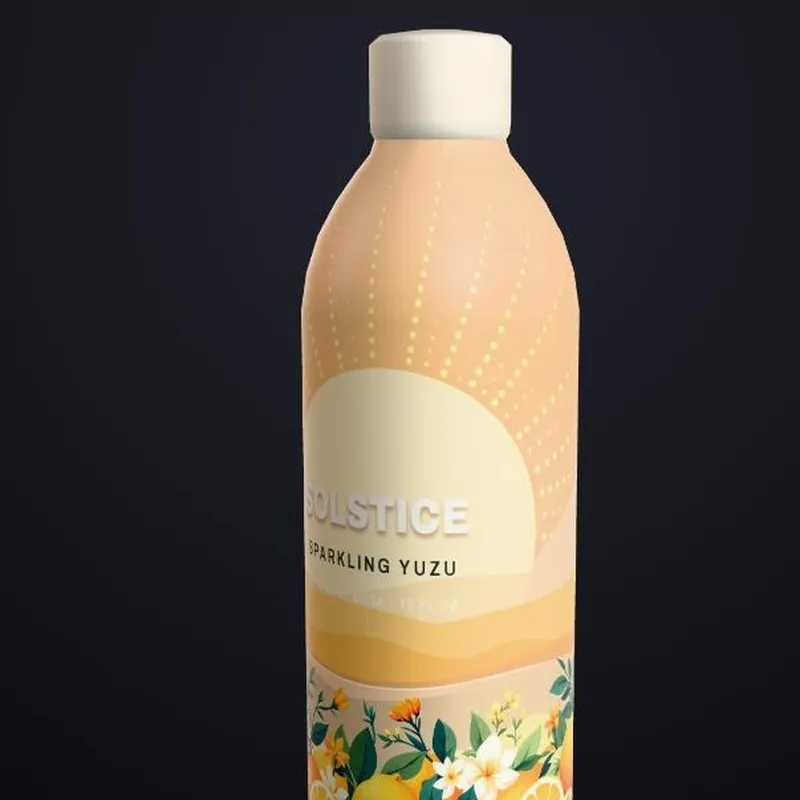
Spin the sleeved bottle in 3D
Our retail packaging page has a drag-to-rotate 3D sample table, including a full-body shrink-sleeve bottle with distortion-compensated art. Watch the design hold as it turns.
Shrink Sleeve Labels: questions, answered.
Should I use a shrink sleeve or a pressure-sensitive label?
Let the container decide. If it is straight-sided and the design lives on one or two panels, a pressure-sensitive label is simpler and cheaper to apply. If the shape curves in more than one direction, the art wants full 360-degree coverage, or the package needs built-in tamper evidence, a shrink sleeve is the right tool.
What is the minimum order for custom shrink sleeves?
White Graphics prints short-run sleeves on digital presses, so a few hundred pieces is a workable run for sampling, farmers-market batches, or a regional test. The same file then scales to full production volumes without rework.
What containers can be sleeved: glass, plastic, cans?
Glass bottles and jars, PET and HDPE plastics, aluminum cans and bottles, tubes, and most contoured shapes in between. Bottle shrink sleeves get the spotlight, but the format's real advantage is geometry: the harder a shape is to label flat, the stronger the case for a sleeve. Extreme profiles are limited only by the film's conforming range, which we test before you commit.
How does distortion proofing work?
We print a sleeve carrying a measured grid and shrink it on your container. Reading where each cell lands maps how the film compresses across the shape, zone by zone. That map drives the pre-distortion applied to your artwork, and the corrected file is approved before anything runs at volume.
Can I order tamper-evident shrink bands without a full sleeve?
Yes. Neck bands run as their own product: printed or plain, perforated for clean removal, sized from your cap diameter, skirt height, and neck finish. They pair with any primary label, including a pressure-sensitive one, so you can add tamper evidence to an existing package without redecorating it. Send cap dimensions and we will spec the band.
What is the difference between a full-body and a partial sleeve?
Coverage. A full-body sleeve decorates the container from base to shoulder, and can extend over the cap when tamper evidence is wanted. A partial sleeve covers a defined band, a waist wrap or mid-panel, leaving the rest of the container bare. Partials use less film and simpler application; full-body gives the artwork the entire surface.
How should I set up artwork files for a shrink sleeve label?
Start from our container template. Build vector art with outlined or embedded fonts, images at 300 ppi effective, and color in CMYK with white flagged as its own layer for clear film. Keep the marked seam strip empty and leave the art undistorted: compensation is applied here, against the measured grid for your container.
Part of the retail packaging family.
Every format here runs through the same prepress, color and finishing pipeline. Explore the rest:
Put real numbers on your project.
Send your container, or just its measurements and a photo, and a production person will come back with sleeve options and real pricing. No configurator, a conversation.