
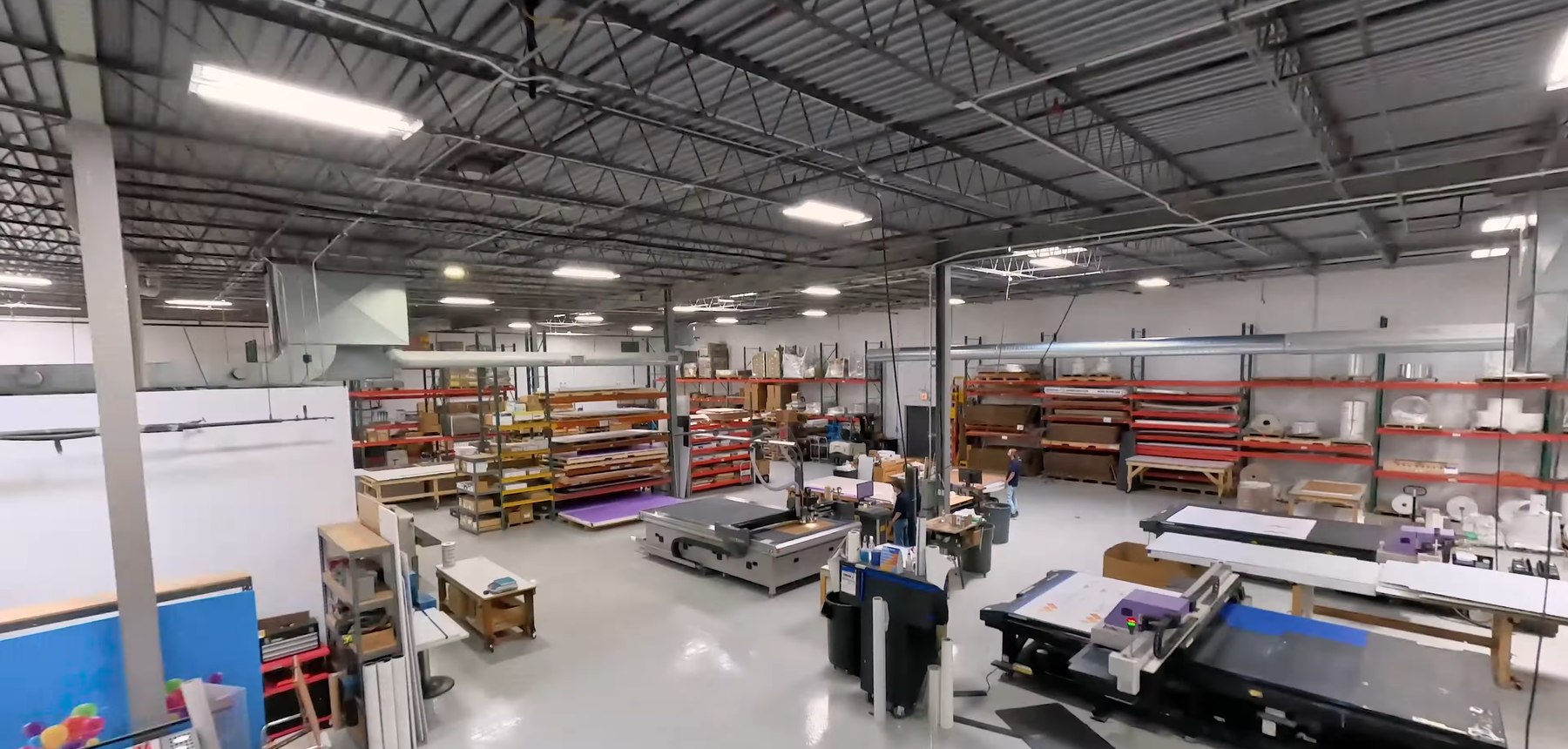
Custom corrugated boxes for the shelf and the doorstep.
White Graphics, a Naperville, Illinois packaging company, designs, prototypes, prints, and die-cuts retail corrugated: one converter that carries a box from the first structural dieline through proofing and into full production, so structure and print are engineered together.
Retail corrugated is a brand surface, not a freight supply.
Corrugated gets bought the way companies buy tape: a strength spec, a unit price, a pallet count. That habit made sense when every box lived and died in a warehouse. It stops making sense the day the box becomes the product's first impression on a store shelf, a club pallet, or a customer's porch. Buying that box on price alone hands your most visible printed real estate to the lowest bidder.
A plain shipping box has one job: survive the truck. Retail corrugated has two. It still has to protect the product through transit, stacking, and handling, and then it has to present that product at the moment of purchase or unboxing. Structure and graphics become one buying decision. Flute grade, board color, dieline, and print quality all pull on each other, which is why we treat corrugated as custom retail packaging rather than a freight line item.
That framing changes what to expect from a supplier. An online configurator will sell you a stock template with your artwork on it; nobody there asks what the box has to survive or how it stacks in a case. Our structural team starts with those questions, because the dieline decides half of how the print lands.
Watch retail corrugated come together.
Read the video transcript
The moment a box carries your brand, it stops being freight. White Graphics designs, prints, and die-cuts retail corrugated: mailers, shippers, trays, and counter displays, with structure and print decided together, from first dieline through production. White Graphics, Naperville. Since nineteen seventy-two.
The custom corrugated boxes we print and die-cut.
Corrugated formats multiply fast once you add print, but most retail programs land on four core structures. Each one below is die-cut and finished, and each is available on kraft or white board, in short runs or full production quantities. If your product doesn't fit any of them, we draw and cut a new dieline to order.
Retail mailer boxes
Roll-end tuck-front mailers are the workhorse of subscription and DTC ecommerce: they ship flat, fold up without glue, and print on every visible panel. We build custom mailer boxes on E-flute for sharp graphics outside and a full second impression when the lid opens.
RSC shippers
The regular slotted container is the box everyone pictures, and custom shipping boxes built on it usually carry case branding, handling marks, and retail-ready graphics, and leave full-bleed art to the mailer and display formats. We print RSCs direct to board so a stockroom aisle reads your brand from thirty feet.
Retail trays
Trays carry multipacks and club-store product to the shelf, then become the shelf presentation when the case is cut open. Tear-away designs and printed interiors turn a shipping unit into retail ready packaging. Corner alignment matters here, and it gets checked on a cut sample first.
Counter display units
Countertop displays put small products where the register line forms. We die-cut, print, and score them to assemble in seconds at the store, and we design them alongside our larger point-of-purchase displays when a program needs the counter and the floor to match.
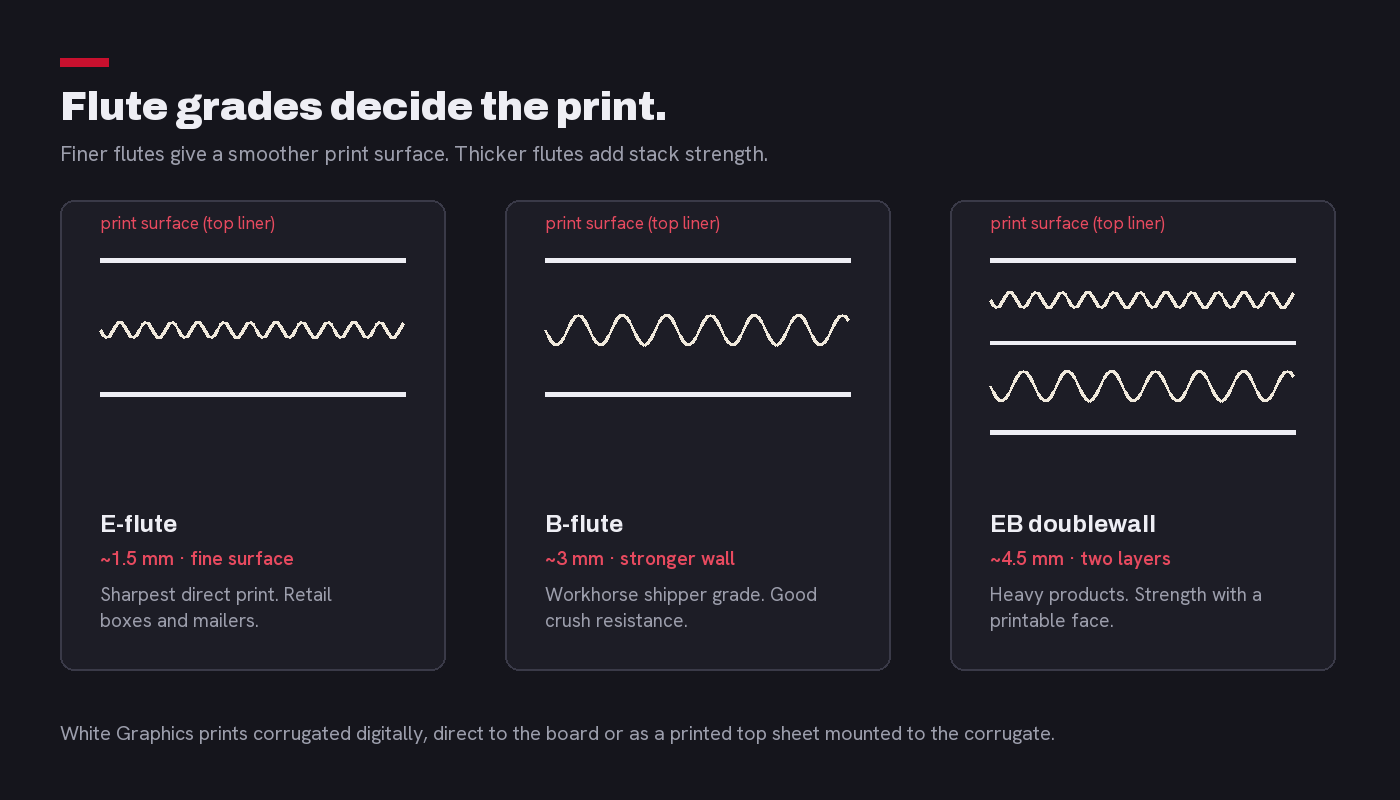
Flute selection decides what corrugated box printing can look like.
Flute is the wave of paper between a corrugated board's liners, and it sets the ceiling on print quality before any ink goes down. E-flute is thin and tight, about 90 flutes per foot, so its surface stays flat enough for fine type, small barcodes, and clean solids. B-flute trades some of that smoothness for crush resistance and stacking strength, which is why shippers and trays lean on it. Doublewall combines two flute profiles when the pack is heavy or the supply chain is rough.
There are two honest ways to put graphics on corrugate, and the flute helps pick between them. Printing digitally direct to board is quick to set up and suits E-flute mailers and short runs, though heavy solids can show a faint washboard where the flutes run. For photographic art or coarser flutes, the better path is a printed top sheet mounted to corrugate: the sheet prints on smooth stock first, then gets mounted to the board, keeping folding-carton print quality on a structural box.
Color management is what makes either path trustworthy. As a G7 Master Qualified plant, White Graphics calibrates to shared gray-balance targets, so the brand red on an E-flute mailer matches the same red on a mounted top sheet, a label, or a folding carton. That matters most when corrugated is one piece of a larger brand system alongside your cartons and labels.
Setting up artwork for corrugated: surfaces, panels, and crush.
Corrugated artwork starts with a question flat work never asks: which surfaces print? A mailer can carry graphics on the outside, the inside, or both, and each surface is a separate zone of the dieline with its own bleed. Panels that wrap a corner need continuous art across the fold, and the score line will eat a millimeter or two of it. Build wrap graphics to survive that, and keep critical type away from every crease.
Board color behaves like part of the ink set. On white liners, color sits close to what your monitor promised. On kraft, the brown fiber shifts everything warm and dark, which either becomes the aesthetic or gets corrected with a white underlay printed beneath the graphics. Our presses lay down white as a spot layer, so a kraft box can hold a bright logo in one area and let the raw board show everywhere else.
Corrugate also moves. Board crushes a little under feed rollers and the die, and registration across a wide panel is looser than label work, so hairline borders and tight knockouts are the first things to fail. We design around that, then prove it: every new structure gets prototyped on the real board before a run, cut, folded, filled, and stress-tested the way a carrier would treat it.
The Corrugated Box Artwork & Structure Guide
Flute selection, mailer dieline anatomy, print surfaces, crush and registration allowances, and the prepress checklist, on two printable pages.
Where custom corrugated boxes earn their keep.
A printed box costs more than a plain one, so it has to earn the difference. It earns it wherever the carton is seen by someone who matters: the shopper at the shelf, the subscriber at the door, the buyer opening a sample kit. These are the programs where custom corrugated boxes work hardest for the money.
- Subscription and DTC ecommerce brands treat the mailer as their storefront, because the doorstep is the only shelf they own.
- Food and beverage multipacks ride printed trays and case wraps from pallet to shelf, produced in an FDA-registered facility.
- Cosmetics and personal-care kits pair E-flute structures with printed interiors so the unboxing matches the price point of what's inside.
- Electronics programs need crush protection and clean panel graphics in one box, often with die-cut inserts that keep accessories from rattling.
- Counter retail lives on small die-cut display units that sell impulse products where the checkout line forms.
- Club-store trays ship as freight and sell as display, and our kitting and fulfilment services pack loaded trays so they arrive dock-ready.
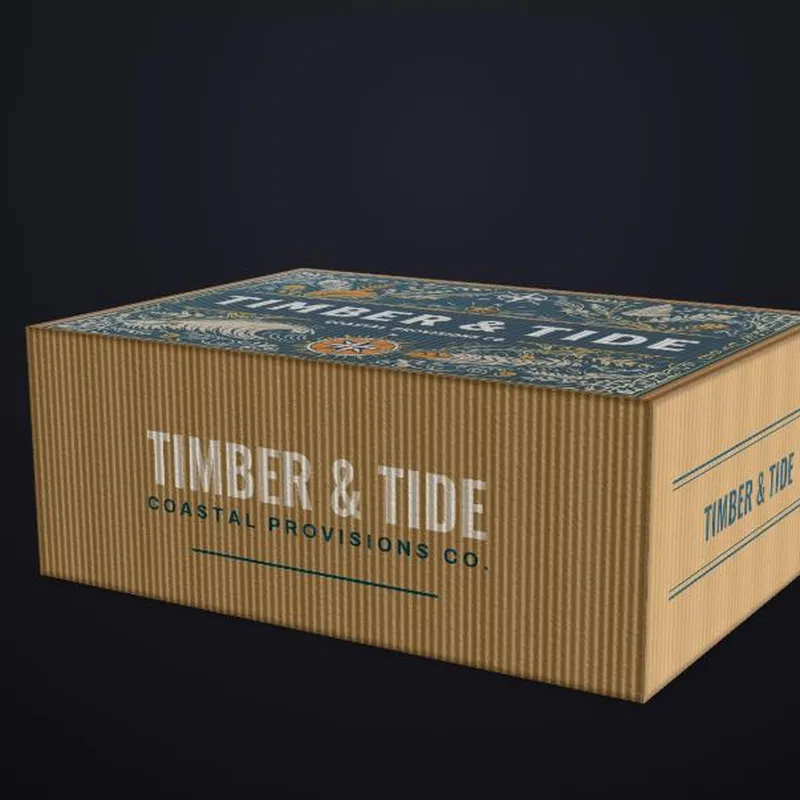
Turn the box over in 3D first
The retail packaging page carries a drag-to-rotate 3D sample table with a printed corrugated retail box on it. Spin it, then ask for the physical sample.
Custom Corrugated Boxes: questions, answered.
What drives the cost of custom corrugated boxes?
Board grade and box size set the base, since corrugated is priced largely by the square footage of board in each blank. The big levers after that: flute choice, kraft versus white liners, printing one surface or two, white underlay coverage, direct-to-board versus a mounted top sheet, and run length. A new structure adds tooling for the cutting die; reruns of the same dieline reuse it.
What is a practical minimum order for printed corrugated boxes?
Digital printing removed the old plate economics, so printed corrugated boxes are workable in runs of a few hundred, and a prototype can run as a single unit. The honest floor depends on structure: a simple E-flute mailer makes sense at smaller quantities than a mounted-sheet club tray. Send specs through the quote form and you'll get a real number for your specific box.
Should I use a mailer box or a shipping box for ecommerce?
Match the box to the journey. A mailer suits products that ship one at a time and deserve a presentation moment: it folds from a single die-cut blank, closes with its own tuck flaps, and prints well inside and out. An RSC shipper suits case packs, heavier items, and freight lanes where stacking strength outranks looks. Plenty of brands run both, a printed mailer riding inside a plain protective shipper.
Can you print on the inside of a corrugated box?
Yes. Inside printing is a standard part of corrugated box printing on our digital equipment. Mailers benefit most, since the lid interior and base face the customer the moment the box opens. Treat the inside as its own print surface on the dieline, with its own bleed and clearances, and remember that kraft interiors usually want a white underlay behind any color that has to stay accurate.
How do I choose the right flute for a printed box?
Start from what the box has to survive, then take the finest flute that clears it. E-flute prints cleanest and folds sharpest, making it the default for retail mailers and cartons. B-flute adds crush resistance for shippers and stacked trays. Doublewall covers heavy products and rough freight. When the structure demands a coarse flute but the graphics are fine, a printed top sheet mounted to corrugate delivers both.
Kraft or white corrugated: which is better for printing?
Neither wins outright; they do different jobs. White board reproduces brand color faithfully and supports photography, which suits cosmetics and anything color-critical. Kraft reads natural and hides scuffs, but the brown fiber mutes ink, so bright marks need white printed underneath them. When a brand is torn, we proof the same art on both boards, because a screen never settles it.
How fast can you produce custom printed boxes?
Speed here is a property of the workflow. Digital printing needs no plates, and prototyping, printing, die-cutting, and finishing run in sequence. Share your in-hands date when you request a quote and we'll tell you straight whether it holds.
Part of the retail packaging family.
Every format here runs through the same prepress, color and finishing pipeline. Explore the rest:
Put real numbers on your project.
Send dimensions, product weight, and where the box has to go, and a production person will come back with structure options and real pricing. No configurator, a conversation.